What time feels like
To exist is to exist in time. We remember the past, navigate the present, dream of the future. Time sometimes flies by, sometimes drags on. The endless summers of our childhood contrast the accelerating feeling of time as we age.
Whatever the material reality of time, we experience it in uniquely personal ways.
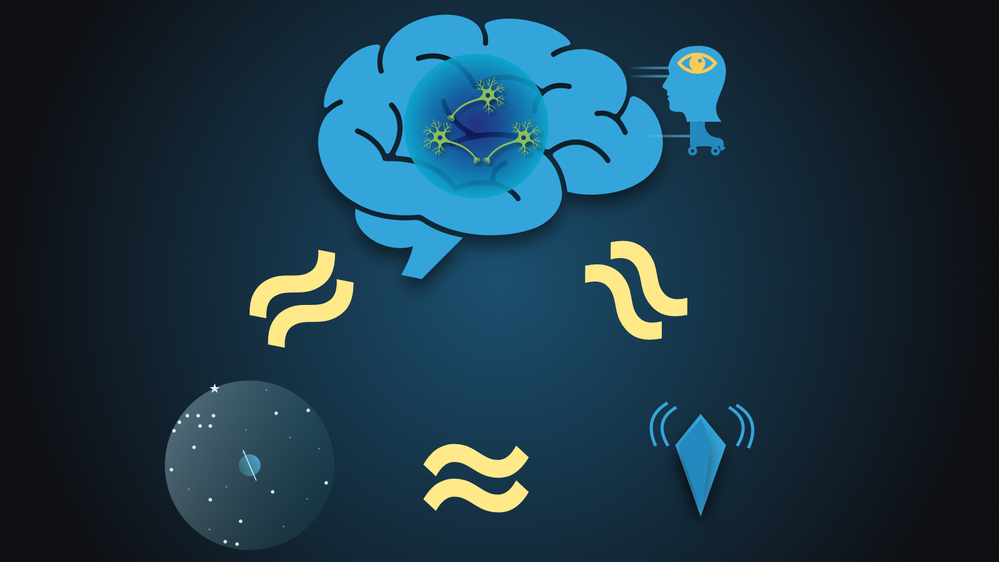
Neuroscience and Time
See the work of Dean Buonomano, especially “Your Brain is a Time Machine”. He’s collaborated on papers with Carlo Rovelli, and been interviewed by Sean Carroll.
Daniel Kahneman shared the Nobel Prize for his work including the concepts of System One and System Two thinking. System One thinking is fast and intuitive; System Two deliberative. This framework underpins recent robotic AI efforts from Google.
The language we speak influences how we experience and tink about time. See the work of Lera Boroditsky:
Logarithmic Time Perception
[Warning: this might bum you out.]
As you get older, each additional year represents a smaller percentage of the total time you’ve lived – one possible mechanism behind the feeling that “time speeds up” as you age.
This sounds reasonable enough, but seeing it graphically really emphasizes how much of your experienced life is behind you. Combine this with the fact that most people don’t form lasting clear memories until they’re a few years old, and you arrive at Ryan Mouton’s statement: “Childhood is half of life”.
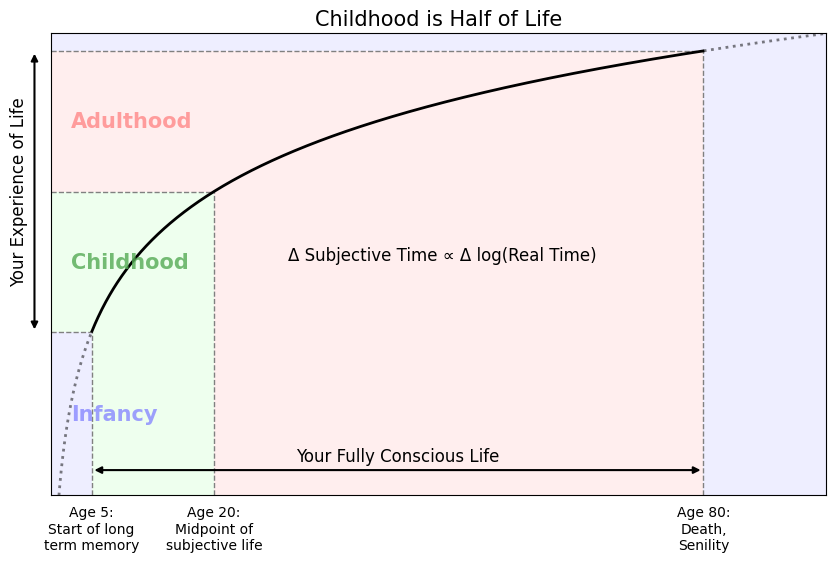
https://moultano.wordpress.com/2025/12/30/children-and-helical-time/
From Data To Meaning
Or, a thousand words on pressing a button
In Physical Computing, we are immediately confronted with the difficulty of understanding what is actually going on in the world around us. Consider the very first input we learn, the humble button. It has two states, pressed or not-pressed, and we learn a circuit (pin to ground through a pull down resistor, pin to +V via the button) that converts this state into a changing high or low voltage. It should be easy to tell if the button is pressed, and how often, right?
But a simple program that counts button presses faces a few problems. Our first-draft program might increment a variable whenever the voltage at the pin is high, corresponding to a pressed button. This will not work, however, because the variable will increment as fast as the main loop executes. If a button is pressed for one second, and the loop happens 498 times in that second, our variable will increment by 498 during that single press.
This can be solved by adding one stage of memory to the program. We can store both the current voltage detected a the pin, and the voltage detected the last time through the loop (with a default initial setting for the very first loop). By comparing the current state to the previous state, we can distinguish between a press (the pin read a low voltage on the last loop and a high voltage on this loop), a release (was high, now is low), and a hold (was high and still is high). By adding a record of the previous state, we should, in theory, have a program that counts up by one for each press of the button regardless of duration.
However, we will immediately encounter a new problem, and to understand it we need to think a bit about how buttons are actually made. A button is not some perfect Platonic concept, it is a real-world object with all the messiness that entails. When we press a typical button, metal contacts are pushed together, completing a circuit. But these contacts are springy (so they smoosh together well) and as a result, when they bump into each other they may actually bounce, rapidly making and breaking the electrical connection. Our microcontrollers are fast – electron fast – and comparatively a button is large and cumbersome. Most microcontrollers could resolve the individual bounces of the switch contacts as they connect.
Our second-draft button-press counting program increments a variable for each change from low to high voltage detected at the pin. This counts presses, but might count some of the bouncing, too. We press once, but we might see the counter go up by one, two, three or more. An action that, to us, seems very easy to discern (“yes, I have definitely now pressed the button one time right now”) is, to a microcontroller, harder, because it only has the raw data, the voltage at the pin, over a very narrow window of time – this loop and the previous loop.
How can we address this? One approach is to expand the time over which the microcontroller considers the pin state. By adding a longer sense of the history of the pin we can “debounce” (yes, that’s the term) the button.
We could record the time that each change is detected. Our microcontrollers have an internal timer (more on that later) that tracks the elapsed number of milliseconds since the program began running. With this, we can modify our program to ignore rapid voltage changes at the beginning or end of a press. We only count a press when the pin reads a high voltage and still reads a high voltage a few milliseconds later. By expanding the window of time analyzed by the program we are able to make better sense of the world around us.
We can take this further. Once we have a handle on the time that events occur, we can distinguish between short, medium, and long presses. We might decide (arbitrarily) that a short press is less than 250 ms, a long press over 1250ms. And further still, if we consider a collection of button presses, we might be able to ascribe an overall state to the set: several long presses in a row could be called “languid”; several short presses in a row “frantic”, and so on.
Note an interesting pattern here. We’ve steadily expanded the window of time we think about from a single instant; to this loop and the last; to a few milliseconds; to about a second; and finally to a history of presses. At each stage we move farther from the raw data of the voltage and closer to a ‘higher’, more subjective meaning (“the button was pressed”, “the button was pressed for a long time”, “the button was pressed languidly”). We also inject our own decisions at each level, each time more subjectively. We can use the oscilloscope to help us decide what window of time would best debounce our switch by observing the signal, but we have to use our judgement to decide what constitutes “short” or “frantic”.
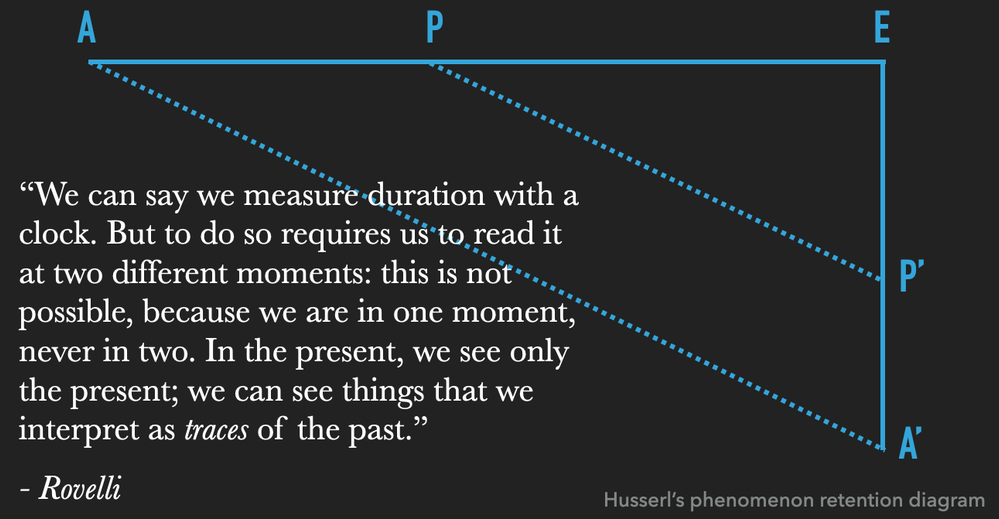
Why is this in the Experiences section? Because the same way the expanding time window gives meaning to the “experience” of a microcontroller, so our memory gives meaning to our perception. Husserl via Rovelli:
Memento Mori
For me, perhaps the most poignant aspect of time is that mine is finite. I have lived a rich and wonderful life and I have many cherished memories. I imagine the future and have hopes for it. But at some point I believe my consciousness will no longer be part of that future. Those memories will be lost. Mortality gives time teeth.
Yet… I find that contemplating my finite existence, rather than being depressing, animates me. It recharges my determination to make the most of the time I have, and to appreciate the present.
(Many traditions hold that we are essentially immortal, and that there is an “after-life”, or that we are reborn again and again. Regardless, the transition from this life to whatever comes next is still regarded as a very significant event.)
I’m not alone in this feeling. In his 2005 commencement speech at Stanford, Steve Jobs said:
Remembering that I’ll be dead soon is the most important tool I’ve ever encountered to help me make the big choices in life. Because almost everything, all external expectations, all pride, all fear of embarrassment or failure—these things just fall away in the face of death, leaving only what is truly important. Remembering that you are going to die is the best way I know to avoid the trap of thinking you have something to lose. You are already naked. There is no reason not to follow your heart.
Steve Jobs
This is an old idea. From Plato’s Phaedo: “For is not philosophy the practice of death?” Japanese kusōzu images support the Buddhist practice of maraṇasati meditation on the nine stages of decay. An 19th century rabbi was said to keep two pieces of paper in his pockets: one reading Bishvili nivra ha-olam, “for my sake the world was created”, and the other V’anokhi afar v’efer, “I am but dust and ashes” and this is frequently invoked during the High Holiday “Days of Awe” in the fall. In European art, a trope known as “Memento Mori” is named after the Latin phrase meaning “remember you will die.”

The purpose of memento mori is memento vivere: rememering to live.
Further topics
- Calendar synesthesia
- Circular vs linear time
- The holiday paradox
- Lemlich subjective time equation
- The oddball/debut effect
- Anachronisms and retronyms
- Anemoia
- Time perception: ego moving vs time moving
- Anthropic principle
- Chronotypes
- Clock dementia test
- Dyson’s six time scales
- Flight dysrhythmia
- Libet clock experiments
- Zimbardo Time Perspective Inventory
Experience Links
Over the years I’ve accumulated about a thousand time-related bookmarks. In 2026, I used Claude Cowork to scan the links, eliminate duplicates and dead ends, and place the remainder in organized categories following the six sections of the syllabus. These are from that process. While I found all these links originally, I haven’t reopened each link to see how Claude did… Spot checking so far seems like this is a valuable improvement, so I’m sharing on the syllabus.
- Why Mortality Makes Us Free — Argues that it’s precisely the deadline of death, not some hypothetical immortality, that gives our choices weight and makes a meaningful life possible.
- Time Perception — A deep dive into why the clock in your head runs faster or slower than the one on the wall, covering the neuroscience, psychology, and biology behind our sense of duration.
- Memento Mori — Traces the “remember you must die” tradition from Stoic philosophers and Roman triumphs to skull rings and vanitas paintings, showing how cultures have used death as a design principle for how to live.
- Libet Experiments — Breaks down Benjamin Libet’s famous finding that the brain’s “readiness potential” fires before we’re consciously aware of deciding to act — and the decades of free-will debate it triggered.
- Karl Popper — A rigorous entry on the philosopher who argued science advances not by proving theories true but by relentlessly trying to prove them false.
- How I Managed to Meditate Every Day for a Year — Simone Giertz documents what a full year of daily meditation actually did, and didn’t do, to her relationship with time and attention.
- Are We Living in a Computer Simulation? Let’s Not Find Out — Makes the darkly funny case that testing the simulation hypothesis is a genuinely bad idea, since discovering the answer might be the very thing that shuts the simulation down.
- What Is Time? — Walks through how Heraclitus, Aristotle, and other ancient thinkers tried to pin down whether time is real, cyclical, or just a trick of human perception.
- A Successful Artificial Memory Has Been Created — Reports on the experiment where scientists implanted a memory of an odor and a shock into a mouse’s brain that had never actually happened, raising real questions about the ethics of editing memory.
- Which of These Two Ways Do You Perceive Time? — AsapSCIENCE explains the two competing mental models people use to picture time, and how that shapes how you plan, worry, and remember.
- Time Is Running Out — Anatol Knotek’s minimalist text-object installations turn the cliche “time is running out” into a physical, visual experience of urgency.
- How Motherhood Changed My Perception of Time — A watch writer’s personal account of how having a child collapsed and stretched her sense of time all at once, from sleepless minutes to vanishing years.
- Symbol Grounding Problem — Explains the puzzle of how words and symbols ever connect to real meaning instead of just pointing to other symbols forever, a problem at the heart of what it means to understand anything.
- Doing Time — Documents Tehching Hsieh’s brutal “One Year Performances,” in which he punched a factory time clock every hour for a year and, separately, lived entirely outdoors for a year, turning sheer endurance of time into art.
- The Mind — A cooperative card game with no talking allowed, where players must play numbered cards in ascending order purely by tuning into a shared, unspoken sense of timing.
- Is Time Real? — Reviews a physicist-philosopher duo’s controversial argument that time isn’t an illusion emerging from something more basic, but the single most fundamentally real feature of the universe.
- The Prisoner’s Dilemma — A quick, clear walkthrough of the classic game-theory scenario that explains why two rational people cooperating is so much harder than it sounds.
- Nietzsche’s Idea of Eternal Return — Unpacks Nietzsche’s thought experiment that asks whether you could stomach living this exact life over and over, forever, and treats your answer as a test of how you feel about your own choices.
- Friedrich Nietzsche Quotes About Time — A curated collection of Nietzsche’s sharpest lines on time, change, and eternity, handy for anchoring class discussion in his own words.
- Perspectum: Stillness Clock, Motion Clock — Two side-by-side interactive clocks — one that only paints when you move, one that only paints when you’re still — turn the abstract question of whether time passes differently in motion versus stillness into something you can watch happen to your own image.
- The Quest by Circadian Medicine to Make the Most of Our Body Clocks — Argues that syncing meals, medications, and workdays to your internal biological clock, not just the wall clock, could make treatments more effective and daily life measurably better.
- Mary Oliver on the Measure of a Life Well Lived — Built around a poem Oliver wrote after surviving cancer, this piece makes the case that a life’s worth is measured by attention and aliveness, not by its length.
- Rebecca Solnit on Trees and the Shape of Time — Solnit uses century-old eucalyptus trees to argue that some living things let us physically stand inside a timespan longer than any human memory, “changing the shape of time” itself.
- Living at Life’s Expense — Montaigne’s blunt 16th-century case that you are dying every moment you’re alive, and that what we really fear about death is the theatrical trappings around it, not death itself.
- How Does Time Change When We Dream? — Cites lucid-dreaming experiments showing that physical tasks performed inside a dream take measurably longer to complete than the same tasks performed awake.
- Do Dreams Occur in Slow Motion? — Asks whether the stretched-out, epic feeling of a dream reflects an actual slowdown of subjective time during sleep, or is just a trick memory plays on us after we wake.
- Flash Lag Illusion — A moving object and a flash in the same spot look misaligned, a simple visual glitch that neuroscientists use to argue the brain doesn’t perceive “now” directly but constantly predicts it.
- Can You Inherit Memories From Your Ancestors? — Digs into the contested science of epigenetic inheritance and whether an ancestor’s trauma or experience can leave a biological trace passed down the family line.
- Do We Have Free Will? — Stacks up head-on-collision takes from Pinker, Sapolsky, Dennett, and Kaku to show that neuroscience has made the free-will debate messier, not closer to settled.
- An Odd Sense of Timing — Recounts an experiment that dropped grad students 150 feet into a safety net to prove that fear makes time feel like it’s slowing down without actually speeding up the brain’s processing.
- Natural Time and Human Experience: Andy Goldsworthy’s Dialogue with Modernity — Traces how Goldsworthy turns melting ice, cracking clay walls, and slowly fading chalk boulders into the actual subject of the artwork, making decay itself the medium.
- Linguistics: When the Past Is in Front of Us — Shows that whether the future feels like it’s ahead of you, behind you, uphill, or downhill depends entirely on the spatial metaphors built into your native language.
- Today Is Not the First Day of Anything, Except the Rest of Your Life — Physicist Janna Levin unpacks why treating “today” as a fresh start is a comforting illusion, since every day is just an arbitrary slice of one continuous, indifferent timeline.
- What Is Time Psychology? — A tour of chronoception research showing that emotion, attention, age, and even your own heartbeat can each independently speed up or drag out your internal sense of time.