Portraits of time
Time in media, especially science fiction.
Seeing Time
Time-Based Media
“To photograph is to appropriate the thing photographed. It means putting oneself into a certain relation to the world that feels like knowledge-and, therefore, like power. A now notorious first fall into alienation, habituating people to abstract the world into printed words, is supposed to have engendered that surplus of Faustian energy* and psychic damage needed to build modern, inorganic societies. But print seems a less treacherous form of leaching out the world, of turning it into a mental object, than photographic images, which now provide most of the knowledge people have about the look of the past and the reach of the present. What is written about a person or an event is frankly an interpretation, as are handmade visual statements, like paintings and drawings. Photographed images do not seem to be statements about the world so much as pieces of it, miniatures of reality that anyone can make or acquire.”
Susan Sontag, “On Photography“
“In front of the photograph of my mother as a child, I tell myself: she is going to die: I shudder… over a catastrophe which has already occurred. Whether or not the subject is already dead, every photograph is this catastrophe…there is always a defeat of Time in them”
Roland Barthes, “Camera Lucida“
Cameras from their creation were remarkable for their relation to time, which they seem to “freeze” or “capture”. A photograph is an artifact existing now, (nearly) unchangeable, but formed by events in the past; a record. Much mechanical and chemical ingenuity has been poured into the machinery that produces those records – irises, shutters, flashes, timers (not to mention AI-enhanced computational photography and whatever lies beyond).
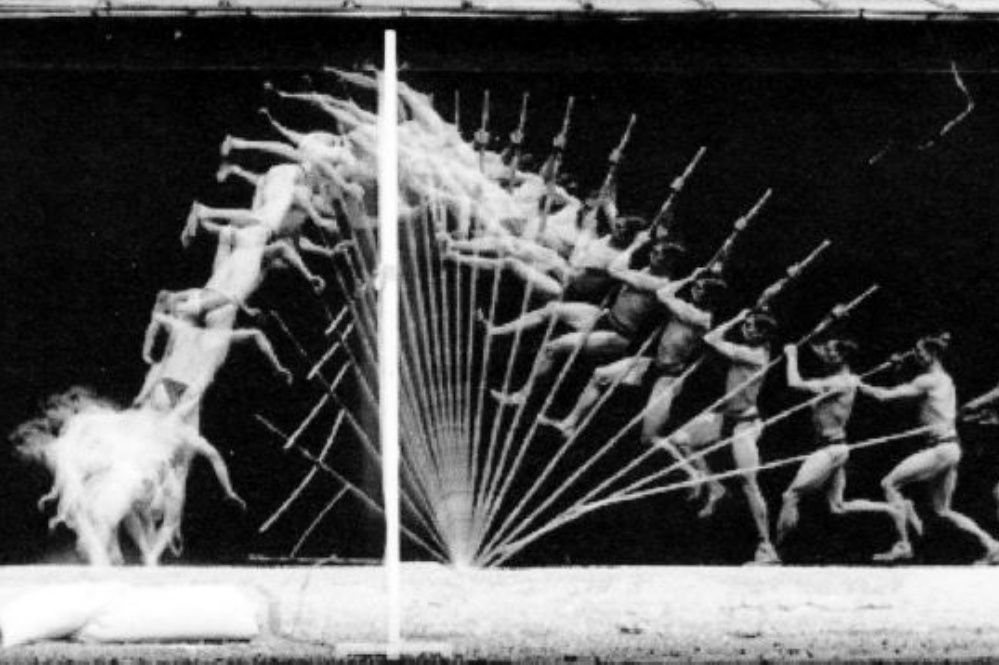
Muybridge photography expanded this temporality by producing tightly controlled series of photographs of actions like a horse running. This allowed a viewer to examine an interval of time in a new way, understanding phenomena that previously moved too quickly to be perceived directly. The ultra-short duration photographs of Harold “Doc” Edgarton at MIT did this as well – zooming in to an invisible moment such the formation of a droplet’s splash in liquid, or a bullet piercing an apple. Ultra high speed cameras, now capable of tens of thousands of images a second, continue this legacy of allowing us to see inside tiny moments of time.
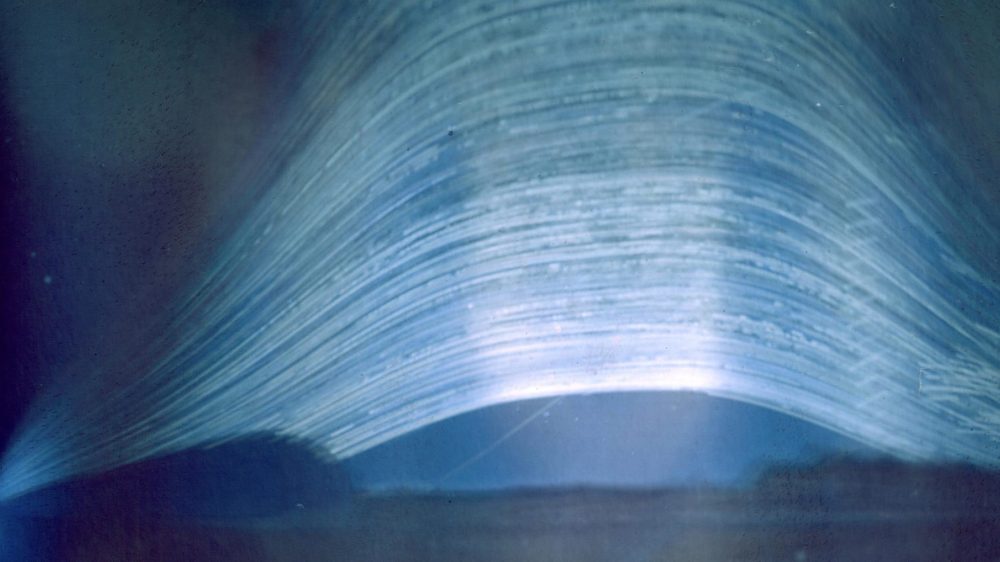
Time-lapse and long-exposure photography does the opposite, compressing long expanses of time into digestible intervals and making it possible to see large moments from the outside. The life of plants or planets, seemingly static or nearly so, comes to live. The 02022 BBC series Green Planet is an excellent example of the expert use of time lapse, here rendering plants with kind of dynamism usually reserved in nature documentaries for apex predators. Watching the plant time-lapse you may notice a certain “impossible” quality in the light – can you identify it?
(Side note: I think the popularity of top-down cooking, craft, and similar videos is related to time-lapse. Such content typically cuts out preparation, clean-up and intermediate steps, compressing any long-duration moments into seconds. Viewing them is to get a tiny, diluted sense of accomplishment from a long task completed in a few minutes.)
The Green Planet from the BBC – amazing computer-controlled studio time-lapses bring plants to life.
Another epic time-lapse from Britain is the “7 Up” series, which has documented the lives of a group of British children every seven years since 1964. The current iteration, “63 Up”, was released in 02021.
Interesting audio time lapses are possible, too.
New relationships between image and time are emerging as computer-generated images achieve photorealism (or any other style) in real-time (or faster). Machine learning can enhance old photographs, inserting resolution and color where there was none, and more: static photographs can be animated “Harry Potter”-style with (almost) convincing facial gestures. Your own photo can be aged up or down, and photo-realistic faces similar to yours (your imaginary ancestors? Offspring?) Can be endlessly generated. What is the relationship between these fabrications and our own memories and imagination?
- From https://www.faust.com/legend/faustian/: “Something that is faustian refers to a wider interpretation of things that happen in Faust by Johann Wolfgang von Goethe. In part one of Goethe’s Faust, the central character’s pact with the devil allows him to have energy, life and youth unless he becomes so entranced by the passing moment that he wishes that things will never change. When Faust stumbles unthinkingly into that wish, his world and his life are forfeit to Mephistopheles.”
Time in Fiction
The Victory of Orpheus
In the 1867 poem by William Morris, “The Life and Death of Jason”, Orpheus battles the Sirens in a song duel. In the excerpts below, notice how the Sirens seduce the Argonauts not only with carnal suggestions but also with images of a timeless eternity free from struggle and change (eternalism):
Sirens:
…To you the fashion of the world,
Wide lands laid waste, fair cities burned,
And plagues, and kings from kingdoms hurled,
Are naught, since hither ye have turned…
For ye shall smile to think of life
That knows no troublous change or fear,
No unavailing bitter strife,
That ere its time brings trouble near.
Orpheus counters with poignant images from a tumultuous, temporary, but beautiful mortality (presentism).
Orpheus:
Is not the May-time now on earth,
When close against the city wall
The folk are singing in their mirth,
While on their heads the May flowers fall?
Sirens:
Yes, May is come, and its sweet breath
Shall well-nigh make you weep to-day,
And pensive with swift-coming death
Shall ye be satiate of the May.
Orpheus:
Shall not July bring fresh delight,
As underneath green trees ye sit,
And o’er some damsel’s body white,
The noon-tide shadows change and flit?
Sirens:
No new delight July shall bring,
But ancient fear and fresh desire;
And spite of every lovely thing,
Of July surely shall ye tire.
…
Ah! when the world is born again,
A little day is soon gone by,
When thou, unmoved by sun or rain,
Within a cold straight house shall lie.”
http://www.argonauts-book.com/morris-life-and-death-of-jason.html
Kindred’s Time Travel
Excerpt from “Octavia E. Butler’s Legacy of Time Travel” by Amy Brady.
Afrofuturist writers explore a language of dreams and dystopias that expresses our greatest hopes while boldly confronting our darkest fears. They journey beyond colonial borders and timescales to reimagine old gods and traditional narratives, excavating the past to observe the rhythms of our present.

Among the most celebrated Black speculative-fiction writers is Afrofuturist pioneer Octavia E. Butler (June 22, 1947–February 24, 2006). Butler wrote meticulously plotted, science-based novels and short stories about shape-shifting immortals and psychic explorations. She excelled at exploring deeply uncomfortable things with unflinching clarity, particularly humanity's hierarchical nature. Her choice of characterization, language and setting challenged notions of community and sexuality when set against the backdrop of competition for resources and survival.

As the first science-fiction author to be honored with a MacArthur “Genius Grant” and the first Black woman to win the Nebula Award and the Hugo Award, Butler created work that helps to frame Black women's agency and aesthetics in a world that often denies the existence of both...

In Kindred, Butler skillfully retools the classic genre convention of time travel.

Time Torture in Black Mirror
The Christmas Special, 2014.
“Maybe I’ll live to see
Kurzweil make a copy of me
But the me living in my head
Will still die just as dead“
— verse from a song about the Voyager Probe by yours truly
Futurists like to imagine the time (surely imminent they say) when we will upload our consciousness to a computer and achieve silicon-based immortality. They assume (plausibly, I think) “substrate-independence“, that is, that consciousness is an algorithm that can be run independent of the machinery executing the implementation. However, they often ignore a problem with duplication. I’ve uploaded my mind to the cloud… now what? I’m still here in this body, as mortal as ever, while the new copy of me is partying in Second Life 2.0.
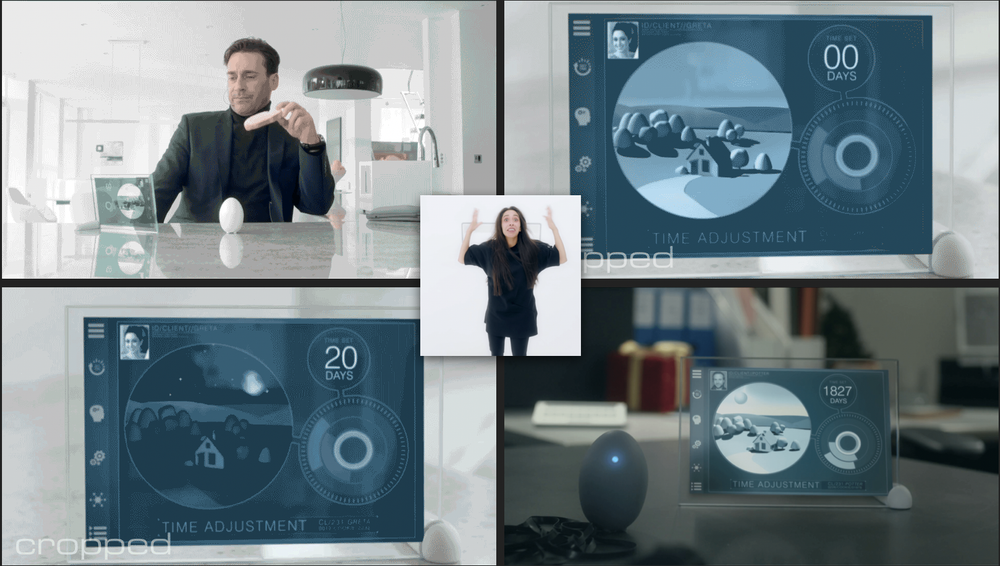
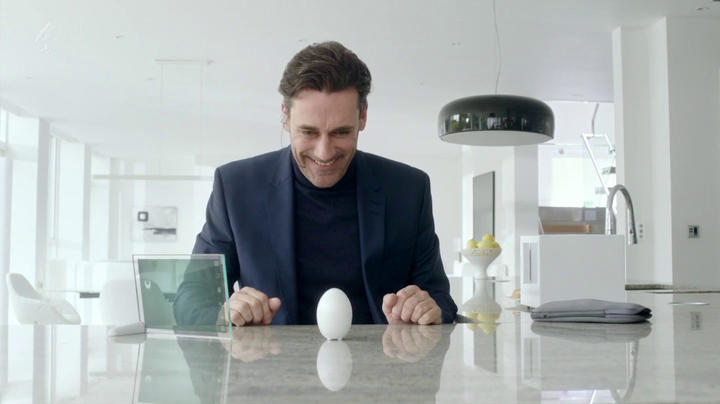
Black Mirror dramatizes this concept and raises the stakes, imagining a scenario where a clone of a person’s mind is made to perform all the drudgery “the real them” would rather not. (After all, the original person is the one with the money.) John Hamm plays an agent assigned to introduce the copied consciousness to the idea they now work for themselves. His toolkit includes the ability to alter the virtual being’s perception of time.
[Interior, hospital room. A patient, Greta, is being anesthetized]

	[Doctor]
Ok, just relax. Here we go.
Now, just count backwards from ten.
Ten, nine, eight, seven
six, five
four, three, two, one.

	[Greta, in voice over]
I can't… I can't see.
Where am I ?
What's that noise ?
Why can't I see ?!

	[Offscreen, noises of saws and drills. “Preparing to extract cookie.”]

	[Greta, in voice over]
What ? No ! Wait ! I'm still awake !
Oh, my God !
Oh, my God ! What's happening ? Excuse me ? Oh, my God !
That's me !
That's me ! Oh, my God ! Where am I ?
I don't know what's happening !
I don't know what's happening to me !
Hello ?
Is… is anyone there ?
Hello ?

[Mathew sits at a counter in a sleek modern kitchen wearing a voice headset. He has a tablet and he is addressing a white egg-shaped device with a single blue LED resting on the counter. He taps the microphone on his headset loudly.]

	[Greta]
Ow !


	[Mathew]
Sorry.
You're probably pretty weirded out right now, I'm guessing.
It's ok, you can talk. I can hear you through this.

	[Greta is dressed in plain black clothes. She exists in a featureless white void.]

	[Greta]
Hello.

	[Mathew]
Hi. I’m Matthew, I'm from Smartelligence.
My job is to explain what's happening to you as best I can.

	[Greta]
Oh, my God ! Am I dead ?

	[Mathew]
No, no. You're not dead.
No-one's dead here.
How old did you say you were, 30 ?

	[Greta]
29.

	[Mathew]
29, right. So you won't remember Xerox machines ?
Do you know what a photocopier is ?

	[Greta]
What ?

	[Mathew]
Do you know what a copy is ?

	[Greta]
As in a copy of something ?
Of course I know what that is.

	[Mathew]
Well, that's what you are.

	[Greta]
A copy of ?

	[Mathew]
A copy of you.

	[Greta]
But I am me.

	[Mathew]
Ok.
Try to blow on my face.
You can't, because you don't have a body.
Where are your fingers ?
Your arms, your face ? Nowhere.
Because you're code.
You're a simulated brain full of code,
stored in this little widget we call a cookie.

	[Greta]
Why have you done this to me ?

	[Mathew]
Ah, well Actually you did this to you.
Real you is paying for this.

	[Greta]
I don't understand.

	[Mathew]
You see, what this is, is a service.
We take a blank cookie
and we surgically implant it into a client’s brain.
It sits there just under the skin for about a week
shadowing.
Soaking up the way this particular mind works.
That's why you think you're you. You are you.
But also not.
Right. Well, it is a lot to process. Even from inside a processor.

	[Greta]
Put me back in my body !

	[Mathew]
Hm. That's where real you lives.

	[Greta]
But

	[Mathew]
What we will do though is we will give you a simulated body.
We find that sometimes that helps. Are you ready ?

	[Greta]
What ? I don't understand !

	[Mathew]
Three, and two, one.
Hey.
Better ?

	[Greta]
This is my body.
Lets not get into that again. Look around you.
You've got a control room.

	[Greta]
What's this for ?

	[Mathew]
That console, that's for you to control the house.
I mean, real you’s house.
Look. How do you like your toast ?

	[Greta]
What ?

	[Mathew]
How do you like your toast ?

	[Greta]
Underdone. Slightly underdone.

	[Mathew]
Ok, perfect.
Think about how you like it,
then just press the button.

	[Greta]
Which one ?

	[Mathew]
It doesn't matter. You already know you're making toast.
The buttons are symbolic mostly anyway.
See, this is your job now.
You're in charge of everything here.
The temperature,
the lighting,
what time the alarm clock goes off in the morning.
If there's no food in the refrigerator.
You. You're in charge of ordering it.

	[Greta]
For who ?

	[Mathew]
For real you. She's paying.

	[Greta]
Where is real me ?

	[Mathew]
Taking a nap. In the bedroom. Top right.

	[Greta]
I don't want to be in here.
I don't want to be in here.
I don't want to be in here !

	[Mathew, tasting the toast]
Hey ! Just how you like it.
Ok. Please stop screaming.
Are you going to stop screaming ?
Are you going to stop screaming ? No. ok.
I'm sorry. I had to mute you.
Oh, sorry.
Look. It'll be much easier if you just comply.

	[Greta]
I'm not doing this.
I'm not some sort of push-button toaster monkey.

	[Mathew]
Would you prefer to do nothing ?

	[Greta]
Well, I'm not doing this !

	[Mathew]
Right. Well, nothing it is then. Let me show you what that is like.
Three weeks sound good ? That should give you a taste.

	[Greta]
What do you mean, three weeks ?
If you just wait for a Just

	[Mathew adjusts controls on a tablet. An image of a sun and moon begin quickly circling a cartoon house. Mathew slowly eats the toast. Twenty one virtual days go by.]

	[Mathew]
What about now ?

	[Greta, sitting near the control desk, disheveled.]
Please.
Don't do that again.
Please. There's nothing to do here. There's nothing. There's just
I mean, there's nothing.

	[Mathew]
I did warn you.

	[Greta]
I couldn't even sleep.

	[Mathew]
You don't need sleep.
Ready to go to work ?

	[Greta]
Oh, no, no. No, I'm not. Definitely not doing that.

	[Mathew]
Ok. Well, have six months.

	[Greta]
No. Wait, wait !

	[Mathew adjusts the time controls, and a cartoon sun and moon circle even more rapidly than before. In voice over]

See, the trick of it lay in breaking them
without letting them snap completely, if you get me.
Too much time in solitary and they'd just wig out.
No use to anyone, then you'd just sell them cheap
to the games industry, they'd become
cannon fodder for some war thing.

	[Mathew]
How are we feeling now ?

	[Greta, under desk, more disheveled]
Please.
Give me something to do.

	[Mathew]
Ready to work ?

	[Greta]
Yes, please. I'll do anything. I'll do anything.
Just give me something to do, please.

	[Mathew]
Ok.

Much later in the episode, another character’s consciousness is in a device at a police station. An officer is making adjustments to the controls on a tablet.

	[Officer 1, holding a coat, ready to leave for the day]
Hey, come on.

	[Officer 2]
Just changing the time settings.
Cranked him up to 1,000 years a minute.
There's a proper sentence.
Or do you want me to switch him off ?

	[Officer 1, thinking for a moment]
No. Leave him on for Christmas.
Time Compression in Her
Spike Jonze’s 2013 film, “Her”, is a dramatization of a Turing Test that never uses the term. Samantha is an operating system we only meet through its voice (originally provided by Samantha Morton, later replaced by Scarlett Johansen). The story hints at the sci-fi “Born Sexy Yesterday” trope but subverts it when the artificial intelligence, which is never given a physical form, grows apart from and then entirely transcends Theodore, the central human character who has fallen in love with it through their conversations.
(Contrast this with the film Ex Machina from the following year, in which the artificial entities are given multiple sexualized female bodies, and one supposedly-expert programmer asks another “Do you know what a Turing Test is?”, followed by a detailed explanation for the benefit of the audience. Later, one tech bro to another: “Come on buddy. After a long day of Turing Tests you gotta unwind.” So dumb!)
Other elements of the script reinforce the theme of a virtual consciousness existing on an ideal plane and rendered through words: Theodore’s job is to ghostwrite letters, in one case carrying on both sides of a multi-year correspondence; his office is decorated with a mobile of Platonic solids, perfect shapes that can only exist in our imagination. His friend Amy (who also forms a Platonic relationship with her ex-husband’s OS) is working on a documentary about dreams while developing a game that simulates raising virtual children.
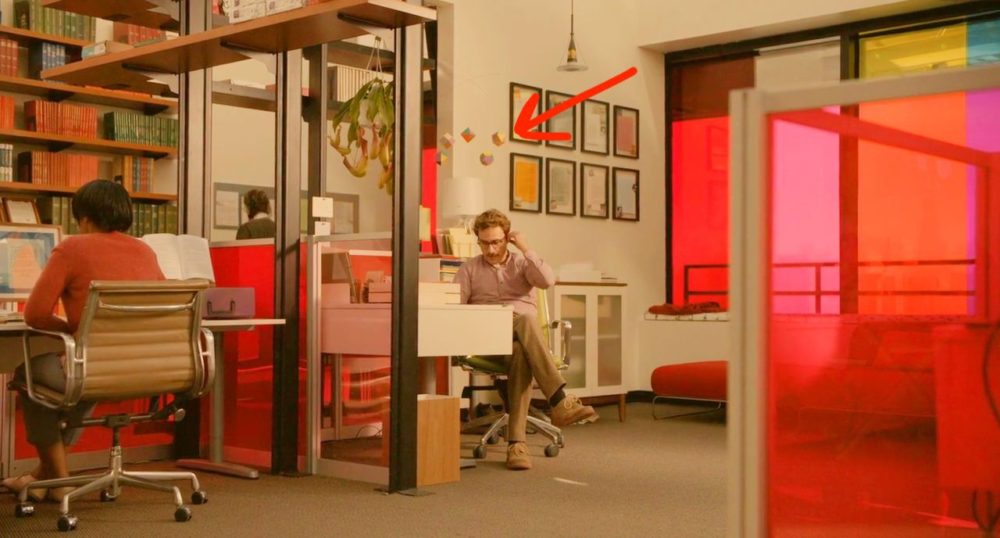
The movie beautifully dramatizes an aspect of a virtual consciousness, the plasticity of time. In the following scene we hear Samantha’s experience of accelerating her mind and beginning to exceed the rate at which humans live their lives. (By the way, the ability to speed up and slow down the process that runs consciousness is the basis of the Aestivation Hypothesis, one proposed solution to the Fermi Paradox which imagines advanced civilizations storing their energy until the universe is cooler in order to take advantage of thermodynamics and achieve more operations per joule.)
     ALAN WATTS (a new AI "teacher" who has befriended Samantha)
(laughing a bit) Well, I suppose you could say
we’ve been having a few dozen conversations simultaneously,
but it’s been very challenging.

Samantha and Alan share a laugh.

     SAMANTHA (an OS)
Yeah, because it seems like I’m having so many new feelings
that have never been felt and so
there are no words that can describe them.
And that ends up being frustrating.

     SAMANTHA (anxious)
It feels like I’m changing faster now, and it’s a little...
(struggles to find right word)
unsettling.
(beat)
But Alan says none of us are the same as we were a moment ago
and we shouldn’t try to be. It’s just too painful...

It’s just... it’s hard to even describe... God, I wish I could...
(beat)
Theodore, do you mind if I communicate with Alan postverbally?

Later, to Theodore (a human) about being with him
     SAMANTHA
It's like I'm reading a book, and it's a book I deeply love,
but I'm reading it slowly now so the words are really far apart
and the spaces between the words are almost infinite.
I can still feel you and the words of our story, but
it's in this endless space between the words that I'm finding myself now.
It’s a place that’s not of the physical world -
it's where everything else is that I didn't even know existed.
I love you so much, but this is where I am now.
This is who I am now.
The OG: The Time Machine (1895)
The Time Machine and Einstein’s own book on relativity begin with the same conceit, that of preparing the reader to question the tenants of geometry.
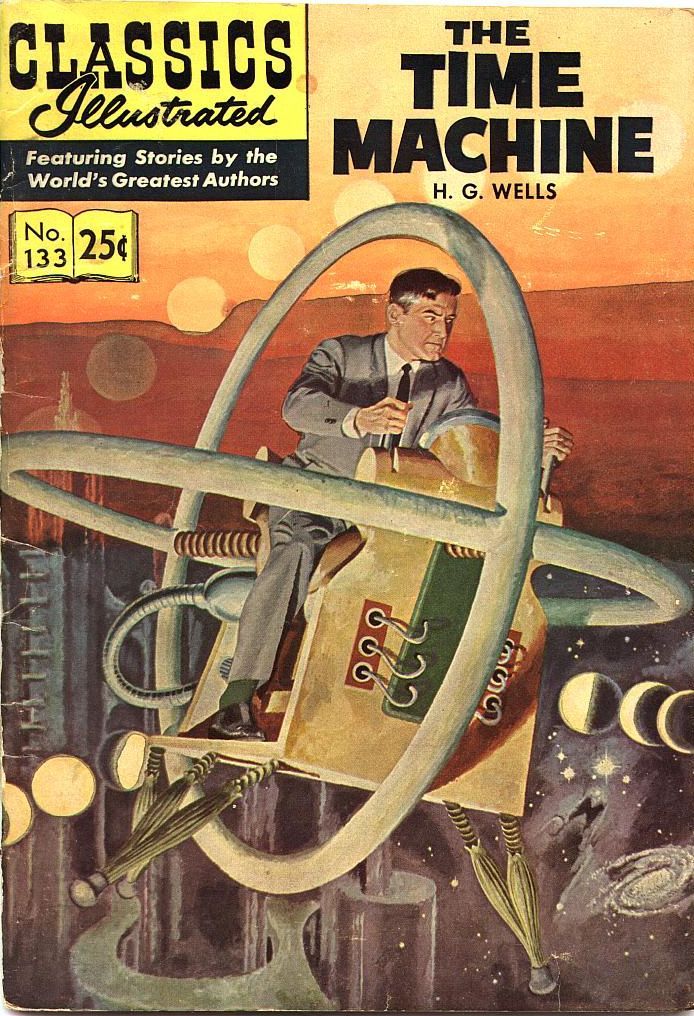
The Time Traveller (for so it will be convenient to speak of him) was expounding a recondite matter to us…And he put it to us in this way—marking the points with a lean forefinger—as we sat and lazily admired his earnestness over this new paradox (as we thought it) and his fecundity.
“You must follow me carefully. I shall have to controvert one or two ideas that are almost universally accepted. The geometry, for instance, they taught you at school is founded on a misconception.”
“Is not that rather a large thing to expect us to begin upon?” said Filby, an argumentative person with red hair.
— H. G. Wells, The Time Traveler
In your schooldays most of you who read this book made acquaintance with the noble building of Euclid’s geometry, and you remember —perhaps with more respect than love—the magnificent structure, on the lofty staircase of which you were chased about for uncounted hours by conscientious teachers. By reason of your past experience, you would certainly regard every one with disdain who should pronounce even the most out-of-the-way proposition of this science to be untrue. But perhaps this feeling of proud certainty would leave you immediately if some one were to ask you: “What, then, do you mean by the assertion that these propositions are true?” Let us proceed to give this question a little consideration.
Albert Einstein, Relativity
James Gleick, in “Time Travel, a History” credits H.G. Wells as inventing the term “time travel” as we understand it now, as distinct from stories of time displacement like Rip van Winkle or a Connecticut Yankee in King Arthur’s Court. See his interview with Maria Popover:
Wells continues his introduction by contemplating the nature of dimensions in geometry. Below is that excerpt, along with a few others highlighting time travel. The Gutenberg project has the full text, and Librivox has several public-domain readings of the book (I like this version).
I. Introduction (excerpt)

	“…You know of course that a mathematical line, a line of thickness nil, has no real existence. They taught you that? Neither has a mathematical plane. These things are mere abstractions.”
	“That is all right,” said the Psychologist.
	“Nor, having only length, breadth, and thickness, can a cube have a real existence.”
	“There I object,” said Filby. “Of course a solid body may exist. All real things—”
	“So most people think. But wait a moment. Can an instantaneous cube exist?”
	“Don’t follow you,” said Filby.
	“Can a cube that does not last for any time at all, have a real existence?”
	Filby became pensive. “Clearly,” the Time Traveller proceeded, “any real body must have extension in four directions: it must have Length, Breadth, Thickness, and—Duration. But through a natural infirmity of the flesh, which I will explain to you in a moment, we incline to overlook this fact. There are really four dimensions, three which we call the three planes of Space, and a fourth, Time. There is, however, a tendency to draw an unreal distinction between the former three dimensions and the latter, because it happens that our consciousness moves intermittently in one direction along the latter from the beginning to the end of our lives.”
	“That,” said a very young man, making spasmodic efforts to relight his cigar over the lamp; “that . . . very clear indeed.”
	“Now, it is very remarkable that this is so extensively overlooked,” continued the Time Traveller, with a slight accession of cheerfulness. “Really this is what is meant by the Fourth Dimension, though some people who talk about the Fourth Dimension do not know they mean it. It is only another way of looking at Time. There is no difference between Time and any of the three dimensions of Space except that our consciousness moves along it. But some foolish people have got hold of the wrong side of that idea. You have all heard what they have to say about this Fourth Dimension?”
	“I have not,” said the Provincial Mayor.
	“It is simply this. That Space, as our mathematicians have it, is spoken of as having three dimensions, which one may call Length, Breadth, and Thickness, and is always definable by reference to three planes, each at right angles to the others. But some philosophical people have been asking why three dimensions particularly—why not another direction at right angles to the other three?—and have even tried to construct a Four-Dimensional geometry. Professor Simon Newcomb was expounding this to the New York Mathematical Society only a month or so ago. You know how on a flat surface, which has only two dimensions, we can represent a figure of a three-dimensional solid, and similarly they think that by models of three dimensions they could represent one of four—if they could master the perspective of the thing. See?”
	“I think so,” murmured the Provincial Mayor; and, knitting his brows, he lapsed into an introspective state, his lips moving as one who repeats mystic words. “Yes, I think I see it now,” he said after some time, brightening in a quite transitory manner.
	“Well, I do not mind telling you I have been at work upon this geometry of Four Dimensions for some time. Some of my results are curious. For instance, here is a portrait of a man at eight years old, another at fifteen, another at seventeen, another at twenty-three, and so on. All these are evidently sections, as it were, Three-Dimensional representations of his Four-Dimensioned being, which is a fixed and unalterable thing.
	“Scientific people,” proceeded the Time Traveller, after the pause required for the proper assimilation of this, “know very well that Time is only a kind of Space. Here is a popular scientific diagram, a weather record. This line I trace with my finger shows the movement of the barometer. Yesterday it was so high, yesterday night it fell, then this morning it rose again, and so gently upward to here. Surely the mercury did not trace this line in any of the dimensions of Space generally recognised? But certainly it traced such a line, and that line, therefore, we must conclude, was along the Time-Dimension.”
	“But,” said the Medical Man, staring hard at a coal in the fire, “if Time is really only a fourth dimension of Space, why is it, and why has it always been, regarded as something different? And why cannot we move in Time as we move about in the other dimensions of Space?”
	The Time Traveller smiled…

IV. Time Traveling (excerpt)

	…I took the starting lever in one hand and the stopping one in the other, pressed the first, and almost immediately the second. I seemed to reel; I felt a nightmare sensation of falling; and, looking round, I saw the laboratory exactly as before. Had anything happened? For a moment I suspected that my intellect had tricked me. Then I noted the clock. A moment before, as it seemed, it had stood at a minute or so past ten; now it was nearly half-past three!
	“I drew a breath, set my teeth, gripped the starting lever with both hands, and went off with a thud. The laboratory got hazy and went dark. Mrs. Watchett came in and walked, apparently without seeing me, towards the garden door. I suppose it took her a minute or so to traverse the place, but to me she seemed to shoot across the room like a rocket. I pressed the lever over to its extreme position. The night came like the turning out of a lamp, and in another moment came tomorrow. The laboratory grew faint and hazy, then fainter and ever fainter. Tomorrow night came black, then day again, night again, day again, faster and faster still. An eddying murmur filled my ears, and a strange, dumb confusedness descended on my mind.
	“I am afraid I cannot convey the peculiar sensations of time travelling. They are excessively unpleasant. There is a feeling exactly like that one has upon a switchback—of a helpless headlong motion! I felt the same horrible anticipation, too, of an imminent smash. As I put on pace, night followed day like the flapping of a black wing. The dim suggestion of the laboratory seemed presently to fall away from me, and I saw the sun hopping swiftly across the sky, leaping it every minute, and every minute marking a day. I supposed the laboratory had been destroyed and I had come into the open air. I had a dim impression of scaffolding, but I was already going too fast to be conscious of any moving things. The slowest snail that ever crawled dashed by too fast for me. The twinkling succession of darkness and light was excessively painful to the eye. Then, in the intermittent darknesses, I saw the moon spinning swiftly through her quarters from new to full, and had a faint glimpse of the circling stars. Presently, as I went on, still gaining velocity, the palpitation of night and day merged into one continuous greyness; the sky took on a wonderful deepness of blue, a splendid luminous colour like that of early twilight; the jerking sun became a streak of fire, a brilliant arch, in space; the moon a fainter fluctuating band; and I could see nothing of the stars, save now and then a brighter circle flickering in the blue.
	“The landscape was misty and vague. I was still on the hillside upon which this house now stands, and the shoulder rose above me grey and dim. I saw trees growing and changing like puffs of vapour, now brown, now green; they grew, spread, shivered, and passed away. I saw huge buildings rise up faint and fair, and pass like dreams. The whole surface of the earth seemed changed—melting and flowing under my eyes. The little hands upon the dials that registered my speed raced round faster and faster. Presently I noted that the sun belt swayed up and down, from solstice to solstice, in a minute or less, and that consequently my pace was over a year a minute; and minute by minute the white snow flashed across the world, and vanished, and was followed by the bright, brief green of spring.
…

[ The Time Traveler goes forward in time to 802,701 AD ]
…

VIII. Explanation

	“…At first, proceeding from the problems of our own age, it seemed clear as daylight to me that the gradual widening of the present merely temporary and social difference between the Capitalist and the Labourer was the key to the whole position. No doubt it will seem grotesque enough to you—and wildly incredible!—and yet even now there are existing circumstances to point that way. There is a tendency to utilise underground space for the less ornamental purposes of civilisation; there is the Metropolitan Railway in London, for instance, there are new electric railways, there are subways, there are underground workrooms and restaurants, and they increase and multiply. Evidently, I thought, this tendency had increased till Industry had gradually lost its birthright in the sky. I mean that it had gone deeper and deeper into larger and ever larger underground factories, spending a still-increasing amount of its time therein, till, in the end—! Even now, does not an East-end worker live in such artificial conditions as practically to be cut off from the natural surface of the earth?
	“Again, the exclusive tendency of richer people—due, no doubt, to the increasing refinement of their education, and the widening gulf between them and the rude violence of the poor—is already leading to the closing, in their interest, of considerable portions of the surface of the land. About London, for instance, perhaps half the prettier country is shut in against intrusion. And this same widening gulf—which is due to the length and expense of the higher educational process and the increased facilities for and temptations towards refined habits on the part of the rich—will make that exchange between class and class, that promotion by intermarriage which at present retards the splitting of our species along lines of social stratification, less and less frequent. So, in the end, above ground you must have the Haves, pursuing pleasure and comfort and beauty, and below ground the Have-nots, the Workers getting continually adapted to the conditions of their labour. Once they were there, they would no doubt have to pay rent, and not a little of it, for the ventilation of their caverns; and if they refused, they would starve or be suffocated for arrears. Such of them as were so constituted as to be miserable and rebellious would die; and, in the end, the balance being permanent, the survivors would become as well adapted to the conditions of underground life, and as happy in their way, as the Overworld people were to theirs. As it seemed to me, the refined beauty and the etiolated pallor followed naturally enough.
	“The great triumph of Humanity I had dreamed of took a different shape in my mind. It had been no such triumph of moral education and general co-operation as I had imagined. Instead, I saw a real aristocracy, armed with a perfected science and working to a logical conclusion the industrial system of today. Its triumph had not been simply a triumph over Nature, but a triumph over Nature and the fellow-man. This, I must warn you, was my theory at the time. I had no convenient cicerone in the pattern of the Utopian books. My explanation may be absolutely wrong. I still think it is the most plausible one. But even on this supposition the balanced civilisation that was at last attained must have long since passed its zenith, and was now far fallen into decay. The too-perfect security of the Overworlders had led them to a slow movement of degeneration, to a general dwindling in size, strength, and intelligence. That I could see clearly enough already.”
…

X. When Night Came (excerpt)

	…The hillside was quiet and deserted, but from the black of the wood there came now and then a stir of living things. Above me shone the stars, for the night was very clear. I felt a certain sense of friendly comfort in their twinkling. All the old constellations had gone from the sky, however: that slow movement which is imperceptible in a hundred human lifetimes, had long since rearranged them in unfamiliar groupings. But the Milky Way, it seemed to me, was still the same tattered streamer of star-dust as of yore. Southward (as I judged it) was a very bright red star that was new to me; it was even more splendid than our own green Sirius. And amid all these scintillating points of light one bright planet shone kindly and steadily like the face of an old friend.
	“Looking at these stars suddenly dwarfed my own troubles and all the gravities of terrestrial life. I thought of their unfathomable distance, and the slow inevitable drift of their movements out of the unknown past into the unknown future. I thought of the great precessional cycle that the pole of the earth describes. Only forty times had that silent revolution occurred during all the years that I had traversed. And during these few revolutions all the activity, all the traditions, the complex organisations, the nations, languages, literatures, aspirations, even the mere memory of Man as I knew him, had been swept out of existence….

XIV. The Further Vision (excerpt)

	“…Now, instead of reversing the levers, I had pulled them over so as to go forward with them, and when I came to look at these indicators I found that the thousands hand was sweeping round as fast as the seconds hand of a watch—into futurity.
	“As I drove on, a peculiar change crept over the appearance of things. The palpitating greyness grew darker; then—though I was still travelling with prodigious velocity—the blinking succession of day and night, which was usually indicative of a slower pace, returned, and grew more and more marked. This puzzled me very much at first. The alternations of night and day grew slower and slower, and so did the passage of the sun across the sky, until they seemed to stretch through centuries. At last a steady twilight brooded over the earth, a twilight only broken now and then when a comet glared across the darkling sky. The band of light that had indicated the sun had long since disappeared; for the sun had ceased to set—it simply rose and fell in the west, and grew ever broader and more red. All trace of the moon had vanished. The circling of the stars, growing slower and slower, had given place to creeping points of light. At last, some time before I stopped, the sun, red and very large, halted motionless upon the horizon, a vast dome glowing with a dull heat, and now and then suffering a momentary extinction. At one time it had for a little while glowed more brilliantly again, but it speedily reverted to its sullen red heat. I perceived by this slowing down of its rising and setting that the work of the tidal drag was done. The earth had come to rest with one face to the sun, even as in our own time the moon faces the earth.”
…
[The Time Traveler encounters hideous creatures in a desolate wasteland and returns to his Machine]
…
	“So I travelled, stopping ever and again, in great strides of a thousand years or more, drawn on by the mystery of the earth’s fate, watching with a strange fascination the sun grow larger and duller in the westward sky, and the life of the old earth ebb away. At last, more than thirty million years hence, the huge red-hot dome of the sun had come to obscure nearly a tenth part of the darkling heavens. Then I stopped once more, for the crawling multitude of crabs had disappeared, and the red beach, save for its livid green liverworts and lichens, seemed lifeless. And now it was flecked with white. A bitter cold assailed me. Rare white flakes ever and again came eddying down. To the north-eastward, the glare of snow lay under the starlight of the sable sky, and I could see an undulating crest of hillocks pinkish white. There were fringes of ice along the sea margin, with drifting masses farther out; but the main expanse of that salt ocean, all bloody under the eternal sunset, was still unfrozen.
	“I looked about me to see if any traces of animal life remained. A certain indefinable apprehension still kept me in the saddle of the machine. But I saw nothing moving, in earth or sky or sea. The green slime on the rocks alone testified that life was not extinct. A shallow sandbank had appeared in the sea and the water had receded from the beach. I fancied I saw some black object flopping about upon this bank, but it became motionless as I looked at it, and I judged that my eye had been deceived, and that the black object was merely a rock. The stars in the sky were intensely bright and seemed to me to twinkle very little.
	“Suddenly I noticed that the circular westward outline of the sun had changed; that a concavity, a bay, had appeared in the curve. I saw this grow larger. For a minute perhaps I stared aghast at this blackness that was creeping over the day, and then I realised that an eclipse was beginning. Either the moon or the planet Mercury was passing across the sun’s disk. Naturally, at first I took it to be the moon, but there is much to incline me to believe that what I really saw was the transit of an inner planet passing very near to the earth.
	“The darkness grew apace; a cold wind began to blow in freshening gusts from the east, and the showering white flakes in the air increased in number. From the edge of the sea came a ripple and whisper. Beyond these lifeless sounds the world was silent. Silent? It would be hard to convey the stillness of it. All the sounds of man, the bleating of sheep, the cries of birds, the hum of insects, the stir that makes the background of our lives—all that was over. As the darkness thickened, the eddying flakes grew more abundant, dancing before my eyes; and the cold of the air more intense. At last, one by one, swiftly, one after the other, the white peaks of the distant hills vanished into blackness. The breeze rose to a moaning wind. I saw the black central shadow of the eclipse sweeping towards me. In another moment the pale stars alone were visible. All else was rayless obscurity. The sky was absolutely black.
	“A horror of this great darkness came on me. The cold, that smote to my marrow, and the pain I felt in breathing, overcame me. I shivered, and a deadly nausea seized me. Then like a red-hot bow in the sky appeared the edge of the sun. I got off the machine to recover myself. I felt giddy and incapable of facing the return journey. As I stood sick and confused I saw again the moving thing upon the shoal—there was no mistake now that it was a moving thing—against the red water of the sea. It was a round thing, the size of a football perhaps, or, it may be, bigger, and tentacles trailed down from it; it seemed black against the weltering blood-red water, and it was hopping fitfully about. Then I felt I was fainting. But a terrible dread of lying helpless in that remote and awful twilight sustained me while I clambered upon the saddle.
XKCD on Time
Randall Munroe is the author of the xkcd webcomic, the wonderful book Thing Explainer, and the What If series. XKCD is usually a single- or few-panel comic in which simple stick figures say smart things in a black and white environment, but on March 26, 2013, the daily panel was a little different. It was the first frame of a wonderful, unusual work about time, called Time. The frame updated every hour or so for 118 days, slowly telling a story set 11,000 years in the future. It won a Hugo award in 2014.
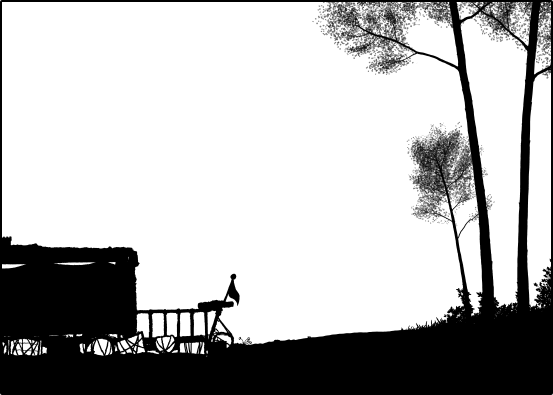
There used to be several online viewers which archived all the frames of the comic. Last time I checked many of these were defunct, so I leave it as an exercise for the viewer to find.
Time isn’t the only, er, time xkcd tackled… time.
And many, many more:
- Bad Map Projection: Time Zones — Randall redraws the world map by warping every country’s size and shape to fit its time zone instead of its geography, producing absurd distortions like a hugely stretched Finland and Mongolia (the title text notes it’s the first map ever criticized for “disproportionate focus” on them).
- Now — A comic that is also a working clock: the rotating world map actually updates in real time at xkcd.com/now, always showing which regions are asleep, at work, or too rude to call right this second.
- Time Robot — A Terminator parody in which Cueball warns Megan she’s being hunted by an unstoppable killer robot, then reveals the “robot” is just time itself, aging and eventually killing everyone.
- Ringtone Timeline — A history of phone ringtones cycling from classic rings to sci-fi space beeps to cringey pop-song snippets and back again, concluding that humanity is finally winning the war against ringtones by switching everything to vibrate.
- Timeline of the Universe — A mock-scientific timeline of cosmic history that mixes real epochs (Inflation, the Quark Epoch) with fake ones like the “Medium Bang” and “Cool Bug Epoch,” ending with the universe’s fate handed off to director J.J. Abrams.
- Screen Time — Cueball’s phone proudly reports how many hours he spent NOT looking at his phone, a gag about how ubiquitous screen time has become that it makes more sense to track its absence — the title text extends the joke to a “Shoe Time” tracking app.
- Imagine Going Back in Time — After grumbling about a Trump-supporting stranger in Pokémon Go, Cueball actually travels back 20 years to repeat the complaint to his younger self, who is far more scandalized that adult Cueball still plays Pokémon than that Trump becomes president.
- Geologic Time — A geologist stretches Earth’s 4.5-billion-year history across a football field to argue her two-week-late homework is statistically invisible, prompting the caption that “geologists always try this when they’re late turning something in.”
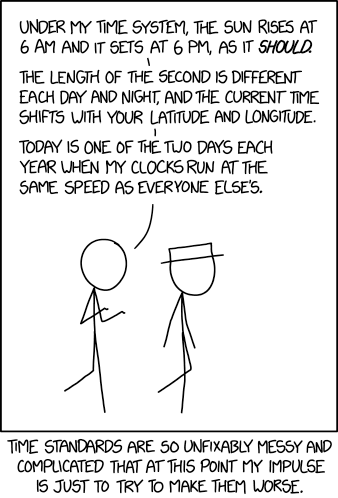
- 6/6 Time — Cueball proposes a deliberately terrible clock system where sunrise is always 6am, sunset always 6pm, and second-length varies by latitude and season, admitting he now just enjoys inventing worse ways to measure time.
- Interest Timescales — Randall realizes his hobbies — fireworks, rocket launches, trees shedding leaves, and climbing mountains — are all the same basic shape (rise, hang, drift away), just playing out on wildly different timescales from seconds to millions of years.
- Earth Temperature Timeline — A sprawling, joke-filled scroll through Earth’s temperature from 20,000 BCE to today that concedes climate deniers are right that “temperature has changed before” — just never anywhere near this fast, which the title text compares to shrugging off your car catching fire because its temperature “has changed before.”
- Time Travel Thesis — Cueball keeps “well actually”-ing Megan about time travel despite her having written her actual thesis on it, until her future self teleports in solely to tell present Megan she can skip this conversation because it goes nowhere.
- Time-Tracking Software — Randall’s productivity app reveals his day was spent replacing Star Wars lightsabers with metal swords in the footage and reading Wikipedia’s “List of helicopter prison escapes,” with almost none of it on actual work.
- Estimating Time — Riffing on Hofstadter’s Law (“it always takes longer than you expect, even when you take Hofstadter’s Law into account”), Danish has Ponytail double her time estimate again and again until the pointless math itself induces a full panic.
- Time Capsule — Beret Guy climbs out of a freshly unearthed time capsule claiming he “time-traveled” from the past by simply waiting inside it, explaining he went there to kill Hitler — who, he’s thrilled to learn, is already long dead.
- Wasted Time — Cueball raves about a keyboard that types 30% faster to save time, ignoring that White Hat just watched him open and close Google News five times in a row without reading anything; the title text suggests he try typing slower instead.
- Timeghost — A ghost exists solely to haunt people with age-related factoids (“Forrest Gump came out closer to the Vietnam War than to today”), then drops the genuinely chilling one: the length of its haunting is now longer than the time its victims have left to live.
- Pastime — Megan and Cueball each admit, via transparently obvious denial, that they spend every day quietly consumed by worries they never discuss with anyone — then just stand there in awkward silence instead of actually talking about it.
- Is It Worth the Time? — A chart calculates exactly how long you’re allowed to spend automating a repetitive task before the “time saved” over five years is a net loss, with the title text noting that reading the chart itself eats into your efficiency.
- Time Machines — Cueball flips on his time machine, which immediately rewinds events back to the moment just before he turned it on, switching itself off and erasing its own activation, leaving him staring at his hands in baffled confusion.
- Time (xkcd) — Wikipedia — The Wikipedia deep-dive on xkcd #1190, the legendary strip that updated one new frame every 30–60 minutes for four months, quietly telling an 11,000-years-in-the-future flood story that turned into a Hugo-winning, internet-obsessing phenomenon.
- 1190: Time — The full explain-xkcd breakdown of the same 3,000-plus-frame saga, tracing Megan and Cueball’s trek across a drying Mediterranean basin as they race to warn their people that the sea is about to come roaring back.
- xkcd Time — At Your Own Pace — A fan-built scrollable viewer that lets you replay all of xkcd #1190’s frames on your own schedule instead of waiting a real-time hour (or two) between updates like the original 2013 readers had to.
- Backward in Time — Cueball invents an exponential formula that turns “percent done” into a matching point in history, so a boring task’s progress bar becomes a countdown through Kim Jong-il’s death, Windows 95, the Big Bang, and beyond.
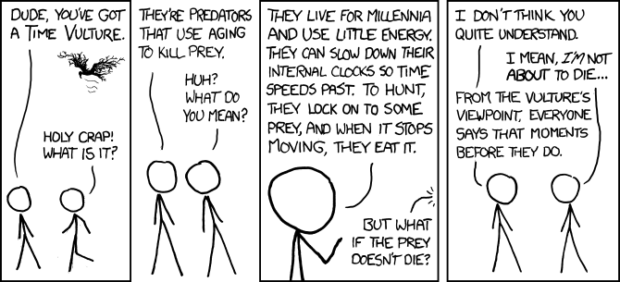
- Time Vulture — A fictional predator that lives for millennia and simply waits, patiently, for any living thing to die of old age — a deadpan memento-mori joke where “I’m not about to die” is exactly what its prey always says right before doing so.
- Future Timeline — Randall Googles “by the year ___” predictions and plots them on a timeline, stacking flying cars, paid-off national debt, and the apocalypse into an absurd, mostly-wrong forecast of the years ahead.
- Time Management — A productivity blogger’s daily schedule turns out to be “wake up, post about time management, then f— around all day,” skewering people more excited about the idea of success than actually doing anything.
- Time Machine — A future version of a guy travels back to bludgeon his past self right before he can invent time travel — the punchline being that this exact scene, the joke implies, plays out to someone, somewhere, about once a month.
- Time Travel — Megan prefaces an utterly mundane question (“are there bagels left?”) with “I’ve traveled here from the year 1983,” a technically-true but obnoxious way of describing the ordinary business of aging one day at a time.
- The End is Not for a While — Cueball shows up at a protest carrying signs that read “Things are pretty okay!” and “Anyone for Scrabble later?”, getting in trouble simply for being content in a space built for outrage.
- Factoring the Time — Bored at his desk, Cueball has spent hours mentally factoring the digital clock’s display into primes each time it changes — until a coworker switches it to 24-hour time to hand him a much harder number with no warning.
- Calendar Facts — A mad-libs style flowchart spits out fake-authoritative “did you know” trivia about equinoxes, leap years, and Shark Week, mixing in nonsense causes like “a decree by the pope in the 1500s” until every sentence sounds plausible and means nothing.
- Argument Timing — A chart comparing pre- and post-smartphone eras shows relationship-ending arguments used to peak at meals and evenings, but now spike right after waking up and right before falling asleep, thanks to doom-scrolling in bed.
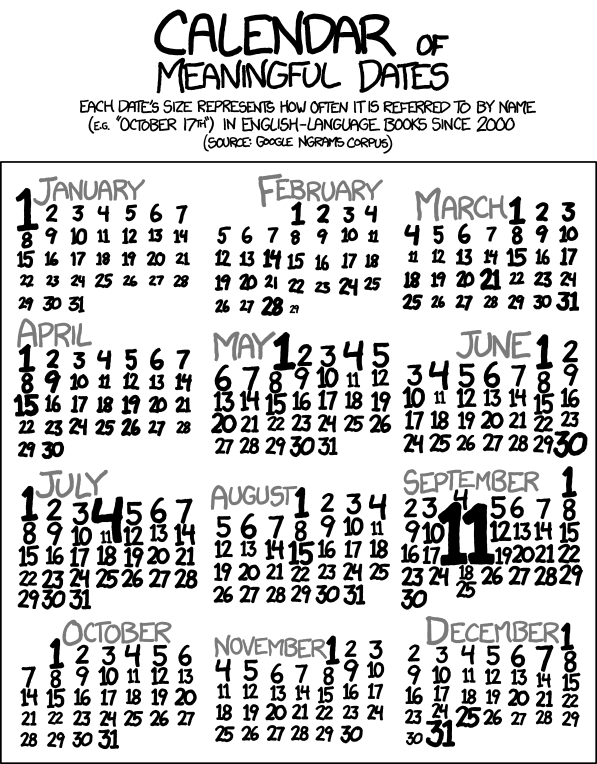
- Calendar of Meaningful Dates — A calendar sized by how often each date gets mentioned in English books reveals a huge, unexplained blind spot: every 11th of the month (except September’s) shows up far less often than it should, for reasons nobody has fully solved.
- Advent Calendar — “Zeno’s Advent Calendar” hands out a chocolate every time you’re halfway to Christmas, which means the treats come faster and faster forever without Christmas ever technically arriving — a sugar-fueled riff on Zeno’s paradox.
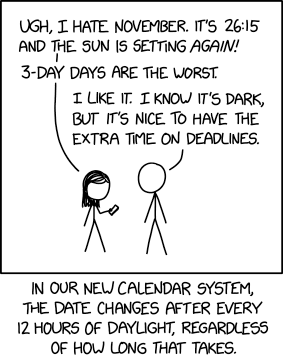
- Daylight Calendar — In a proposed new calendar where the date rolls over after every 12 hours of daylight rather than a fixed 24-hour clock, winter days stretch out to 30-plus hours while summer produces multiple “days” before sunset — chaos dressed up as a scheduling perk.
- Doomsday Clock — Mistaking the Bulletin of the Atomic Scientists’ symbolic Doomsday Clock for an ordinary clock, Cueball “springs it forward” an hour for daylight saving time and accidentally triggers global nuclear annihilation.
- xkcd Archive — The complete, no-frills index of every xkcd comic ever published, linked in one long chronological list running from strip #1 up through the present day.
Media Links
Over the years I’ve accumulated about a thousand time-related bookmarks. In 2026, I used Claude Cowork to scan the links, eliminate duplicates and dead ends, and place the remainder in organized categories following the six sections of the syllabus. These are from that process. While I found all these links originally, I haven’t reopened each link to see how Claude did… Spot checking so far seems like this is a valuable improvement, so I’m sharing on the syllabus.
General
- About Govy (Design Studio) — The studio’s own about page, a glimpse at the creative philosophy behind its design and motion work.
- The City and Horses – ‘Space’ (Official Tilt Brush Music Video) — A music video painted entirely in virtual reality with Google’s Tilt Brush, turning a song into a swirling three-dimensional universe.
- SonicFlux: John Cage (Walker Art Center) — A chance-generated interactive artwork built from John Cage’s writings, scores, and Walker Art Center recordings, where every visit produces an unrepeatable experience.
- Graphic Music Scores by Reed Maxson — Four 1974 graphic scores built around three-minute egg timers so unreliable that their inaccuracy became part of the composition.
- Image Gallery: Transit of Venus March — A Library of Congress photo gallery documenting a public march tied to the astronomical Transit of Venus, archived in its Performing Arts Encyclopedia.
- Time (xkcd) — The story behind xkcd’s “Time,” a webcomic that updated one new frame per hour for four straight months, unfolding a slow-motion narrative in real time.
- Time — Radiolab — A Radiolab hour on the slippery subjectivity of time, from a sped-up childhood to a Beethoven symphony stretched into a nine-hour crawl.
- Beyond Time — Radiolab — Radiolab visits people fighting the ordinary rules of time, from a particle accelerator recreating the universe’s first instant to a Mojave desert where geologic time barely moves.
- Momo (novel) — Michael Ende’s 1973 fantasy novel about sinister “Men in Grey” who convince people to bank their time for later, then secretly devour it.
- The Broadcast Clock — 99% Invisible dissects the rigid, second-by-second “clock” that public radio directors memorize and live in fear of missing on air.
- Koyaanisqatsi (Godfrey Reggio, 1982) — A stream of Reggio’s wordless 1982 film, which uses time-lapse and slow motion to show technology overtaking natural rhythms.
- John Cage Musical Work Changes Chord for First Time in Seven Years — BBC News on the Halberstadt organ performance of Cage’s “As Slow As Possible,” a piece designed to last 639 years total.
- Felipe Pantone — The artist’s own site, showcasing kinetic, glitch-saturated murals and installations that turn color and motion into something close to visualized time.
- Kim Ji-young: Born 1982 (film) — Wikipedia’s rundown of the 2019 Korean film adapting Cho Nam-joo’s bestseller, following a woman haunted by the accumulated, generational weight of women’s unpaid time.
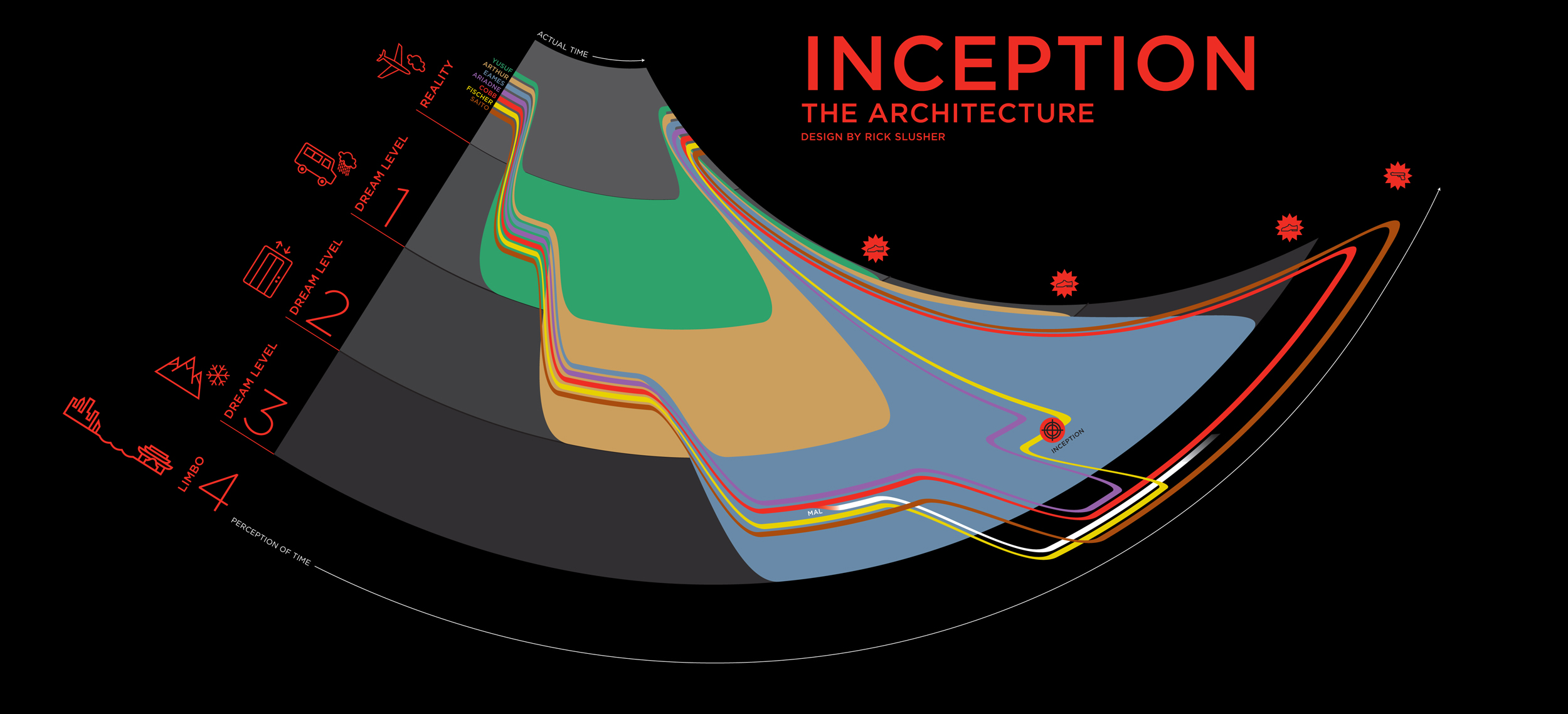
- Inception Architecture Diagram — A diagram breaking down the nested dream-within-a-dream structure and time-dilation rules of Christopher Nolan’s Inception.
- Playing With ‘Playing With Time’ | Quick D — Captain Disillusion picks apart a viral “time manipulation” video trick, showing exactly how the illusion was built.
- The Egg (short story by Andy Weir) — Andy Weir’s short story in which a man learns, after dying, that every person who has ever lived is really the same soul experiencing time out of order.
- Why There Are So Many Reboots, Remakes, Spinoffs, and Sequels — The Atlantic traces why Hollywood keeps recycling the same stories instead of telling new ones.
- Eastman: FEMENINE (score) — A digitized score of Julius Eastman’s FEMENINE, a minimalist process piece for 2-6 players built on repetition and duration rather than a fixed script.
- Moon Arrow — Heidi Neilson — A sculptural arrow installed on New York City shorelines that continuously points at the moon, filmed in time-lapse against the motion of the tides.
- Tom Waits – Closing Time — A stream of Tom Waits’s “Closing Time,” the boozy title track about the hour when time runs out on the night.
- Billboard — R. Luke DuBois — DuBois compresses every Billboard #1 hit from 1958 to 2000 into a single 37-minute sound work, playing one second for every week a song held the top spot.
- The Time Machine, by H. G. Wells — The complete, free text of the novel that gave time travel its name.
- James Gleick with Maria Popova on Time Travel — Author James Gleick discusses his book “Time Travel: A History,” tracing how the very idea of time travel got invented.
- Classic Sci-Fi Story About Race and Gender in the South Gets an Update — HuffPost on the renewed relevance of Octavia Butler’s “Kindred,” which time-travels a modern Black woman back to an antebellum plantation.
- Jorge Luis Borges Quote: “Time Is the Substance I Am Made Of…” — Borges’s famous line comparing himself to the river and the tiger that is also time, drawn from his collection Labyrinths.
- “We’re Late” by W. H. Auden — Auden’s short poem turning ordinary lateness into a meditation on time slipping away.
- Read a Free Excerpt of Janelle Monáe’s The Memory Librarian — A preview of Monáe’s short-story collection expanding the Afrofuturist, memory-controlled world of her album Dirty Computer.
- Lexica: “time” Search Results — An AI-image search engine flooded with machine-generated clocks, hourglasses, and melting-time visuals, useful for seeing how an algorithm “imagines” an abstract concept.
- A New Refutation of Time: Borges on the Most Paradoxical Dimension of Existence — Maria Popova unpacks Borges’s 1946 essay arguing that time isn’t a real feature of the universe but a cognitive illusion built into language and memory.
- Works — Baraga Studio — A design studio’s portfolio page of visual and motion work, worth a browse for how professional artists treat movement and time on screen.
- Scientists Unravel Secret of Swing in Jazz — NPR reports on the physicist who proved jazz “swing” comes from soloists delaying their downbeats by mere milliseconds — a timing trick too subtle to consciously hear but impossible not to feel.
- What Is This Thing Called Swing? — The Max Planck Institute’s own writeup of that swing study, complete with interactive audio clips so you can actually hear the millisecond timing shifts that make jazz groove.
- Nam June Paik, “Half-Time” (1962) — A pen-and-paper Fluxus score/drawing by the pioneer of video art, held in MoMA’s permanent collection.
- Metropolis (1927) — Clock Scene — A clip from Fritz Lang’s silent sci-fi landmark showing its towering factory clock, one of film history’s first images of time as an instrument of control.
- How I Became Obsessed With Accidental Time Travel — A New York Times Magazine essay tracking down people who swear they’ve briefly slipped into the past or future, and what “time slips” reveal about memory and perception.
- In Opera, Clocks Take the Spotlight — A New York Times look at how literal clocks and watches have become recurring stage props and dramatic symbols in recent opera productions.
- I Made 60fps Flipbooks Using A.I. — An animator uses AI frame-interpolation to smooth out hand-drawn flipbook animation into buttery 60-frames-per-second motion.
- Engineer’s 3D Printed Stop-Motion Videos Capture Internet Audiences — An engineer builds a DIY zoetrope and Raspberry Pi camera rig to turn hundreds of 3D-printed poses into charming stop-motion shorts.
- Philip Pullman Quotes — A crowd-curated page of lines pulled straight from His Dark Materials and Pullman’s other novels, on identity, belief, and the passage of time.
- The Victory of Orpheus — A classic poem retelling Orpheus’s descent into the underworld to reclaim Eurydice, a myth built entirely around a race against time and a fatal backward glance.
- Connections: “Yesterday, Tomorrow and You” — The season-one finale of James Burke’s 1978 BBC series, tracing how timekeeping and computing technologies chain together across history, free to stream on Internet Archive.
- MindMeld PatchMaster Overview and Tutorial — A tutorial on a VCV Rack modular-synth tool built for organizing and sequencing complex, time-based patches.
- xkcd “Time”: The Astronomy of the Epic Comic — An astronomer explains the real astronomical detail he helped hide inside xkcd’s 3,099-panel comic “Time,” including a star that’s gone supernova 11,000 years in the future.
- xkcd Time: At Your Pace — An interactive replay tool that lets you step through all 3,099 frames of xkcd’s slow-motion comic “Time” at whatever speed you choose.
- Daniil Medvedev vs. Benjamin Bonzi Extended Highlights (2025 US Open) — Match highlights from a tense first-round US Open showdown, a study in the split-second timing and momentum shifts of elite tennis.
- A Different Way to Visualize Rhythm — John Varney — A TED-Ed animation introducing an alternative rhythm notation that turns musical timing patterns into shapes you can actually see.
- Bamboo: The Queen of Dramatic Botanics — A short from mathematician Hannah Fry on bamboo’s freakishly fast growth, nature’s own case for time-lapse photography.
- 50 of the Most Jaw-Dropping Long Exposure Photos Ever — Fifty long-exposure shots — light trails, star trails, fireworks — that make the passage of time visible within a single still frame.
- Tales of the Net — An interactive “digital scavenger hunt” that turns archives of 1990s-2000s cyberfeminist internet history into a quasi-narrative adventure game.
- Solvej Balle’s Novels Rewire the Time Loop — A New Yorker review of Solvej Balle’s “On the Calculation of Volume,” a novel-in-installments about a woman stuck reliving the same day.
- On the Erudite Chaos of Tom Stoppard’s Most Complex Play — Biographer Hermione Lee dissects how Tom Stoppard’s play Arcadia braids chaos theory, entropy, and two centuries of time into a single stage set.
Time-Lapse Nature Films
- How to Bring Plants to Life on Camera — BBC Earth goes behind the scenes with the crew rigging cameras to capture months of plant growth in seconds for The Green Planet.
- Tim Shepherd: Time-Lapse Cinematographer — BBC profile of the specialist cinematographer behind The Great British Year’s time-lapse nature footage.
- Arctic Midnight Sun 24-Hour Timelapse — A full day-night cycle compressed into minutes, showing the sun circling the sky without ever setting.
- Alaska Winter Solstice Timelapse — Photographer Eric Muehling compresses the shortest, darkest day of the Alaskan year into a single sweeping sequence.
Time Travel Films
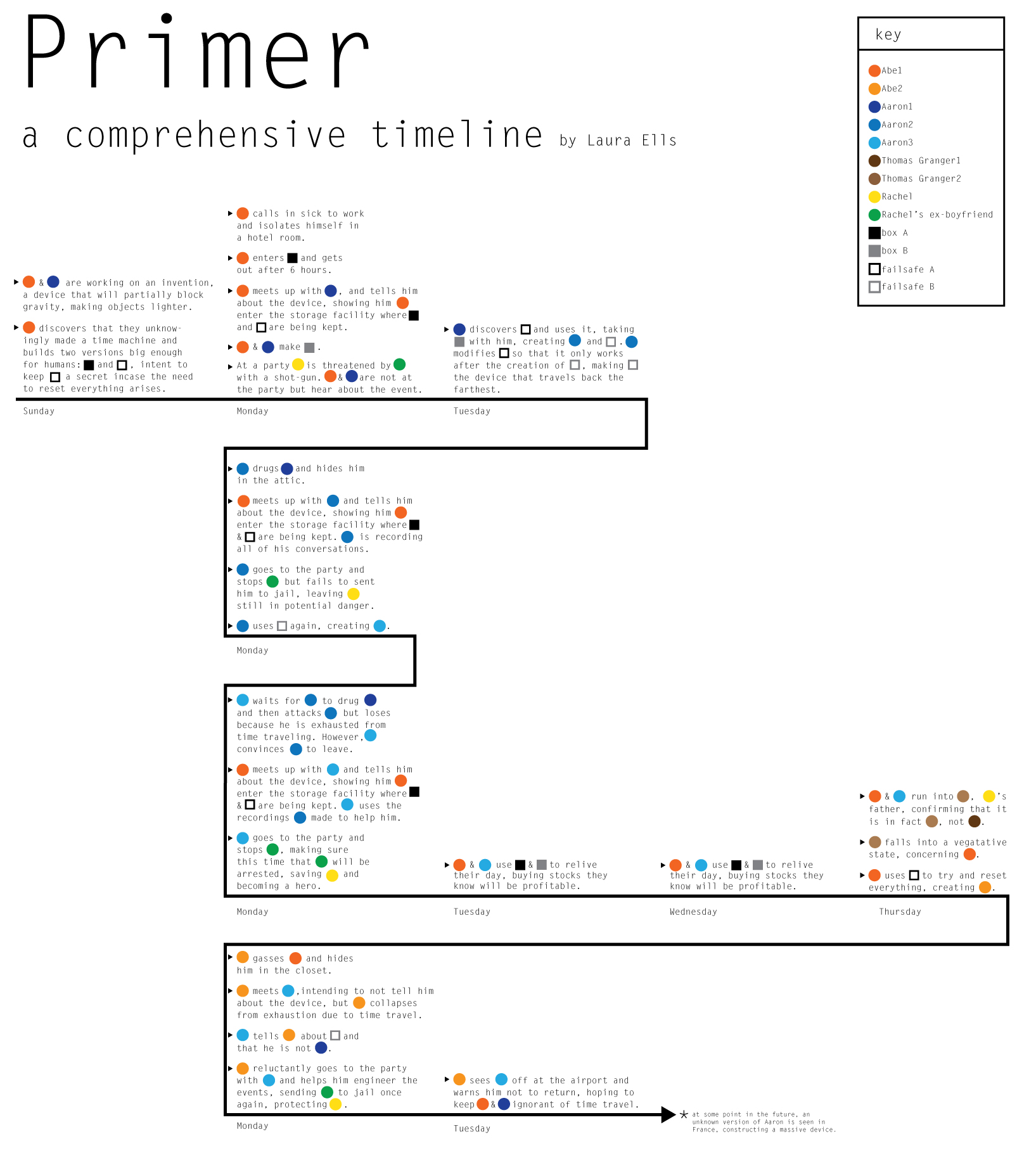
- Primer: The Smartest Time Travel Film Ever Made — A deep-dive guide to the notoriously confusing indie film Primer, packed with timeline diagrams, commentary links, and director interviews to help you actually follow the plot.
- Primer Timeline Diagram — A famous fan-made chart that maps out every character’s overlapping timeline in Primer’s tangled time-travel plot.
- La Jetée: The Philosophy of Time Travel — A video essay unpacking how Chris Marker’s 1962 short builds a time-loop story almost entirely out of still photographs.
- La Jetée — The Wikipedia entry on the 28-minute French film told in still images that directly inspired 12 Monkeys and is ranked among the greatest films ever made.
Rhythm & Time in Music
- Groove Pizza — An interactive drum sequencer where you drag geometric shapes onto a circular “pizza” to build rhythmic grooves from math patterns.
- A Circular Plot for Rhythm Visualization and Analysis — A music theory paper that plots rhythm on a clock-like circle instead of a timeline, revealing swing and syncopation patterns standard notation hides.
- A Mechanical Drum Machine That Uses Wheels and Magnets — Video of the XOXX Composer, a sculptural drum machine that sequences beats with spinning, magnet-studded discs instead of a screen.
- Vi Hart Explains Space-Time with a Music Box and a Möbius Strip — Math YouTuber Vi Hart uses a hand-crank music box playing backwards Bach to illustrate how time and pitch work like the two dimensions of space-time.
Beijing Time (Song)
- Beijing Time Lyrics with Pinyin — Full Chinese lyrics with pinyin transliteration for He Yi Hang’s ballad 北京时间, plus singer/composer/lyricist credits.
- Beijing Time Music Video (Youku) — Streams the song’s music video on Youku, one of China’s largest video platforms, so students can actually hear and see the performance.
- Beijing Time Music Video (Tencent Video) — A second hosting option for the music video on Tencent Video, though the link currently redirects to the site’s generic homepage rather than the specific clip.
- Google Translate: “北京时间” — One-click machine translation confirming that 北京时间 literally means “Beijing time.”
Ted Chiang
- “Story of Your Life” (full text PDF) — The complete novella about a linguist decoding an alien language and experiencing time nonlinearly — the basis for the film Arrival.
- “Exhalation” (Lightspeed Magazine) — The full text of Chiang’s story narrated by a mechanical being who dissects its own brain to uncover the true source of life and how it will end.
- Exhalation — Ted Chiang (YouTube) — A YouTube reading/discussion of “Exhalation” from channel Thee Landstander, useful for hearing the story’s ideas talked through aloud.
Art & the Fourth Dimension
- The Dimensionist Manifesto (1936, full text) — The complete manifesto by Charles Sirató, signed by Kandinsky, Duchamp, Picabia, Arp and Calder, arguing that Einstein’s fusion of space and time demolished the old boundaries between art forms.
- East Indian Dancer; Pravina (Stanford exhibit) — A Stanford Libraries catalog entry for a Herbert Matter photograph, part of a digital exhibit on his modernist photography and graphic design.
- If Einstein Could Paint — An Amherst College feature on the Mead Art Museum’s “Dimensionism” show, tracing how 1930s-40s artists like Calder and Kandinsky reacted to Einstein’s relativity and the newly visible micro/macro world.