What makes time?
Given that this class is called “Time”, depending on your disposition you might find it exciting or scary to know that scientists today debate the very existence of “time”. Is it a fundamental part of the universe? Something real but emergent? An illusion? Do these distinctions matter?
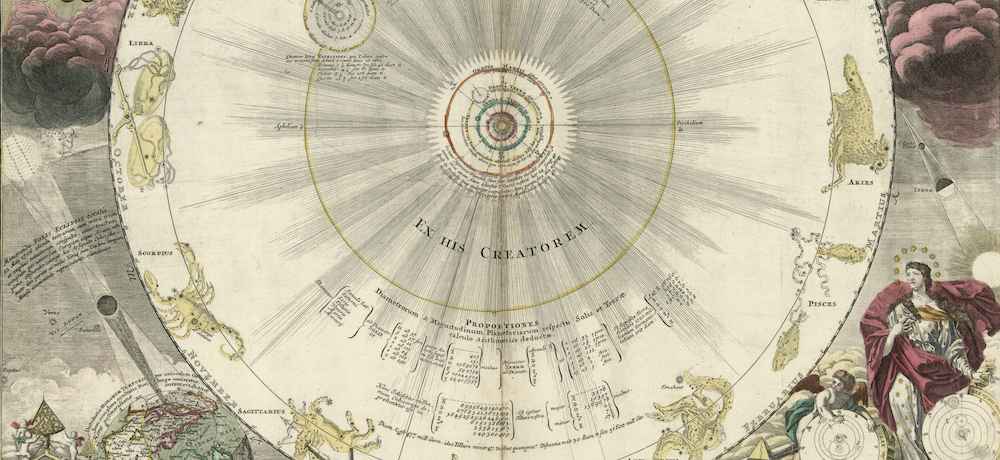
Time and Space
Counterfactual #1: In the book and film “Hail Mary”, the charming alien Rocky comes from planet Erid, which author Andy Weir imagined to have a dense, opaque atmosphere. Any intelligent life on such a planet, gazing upwards, would only ever see an overcast sky, and would never form the kinds of constellation imagery or sky mythology Earth civilizations have.
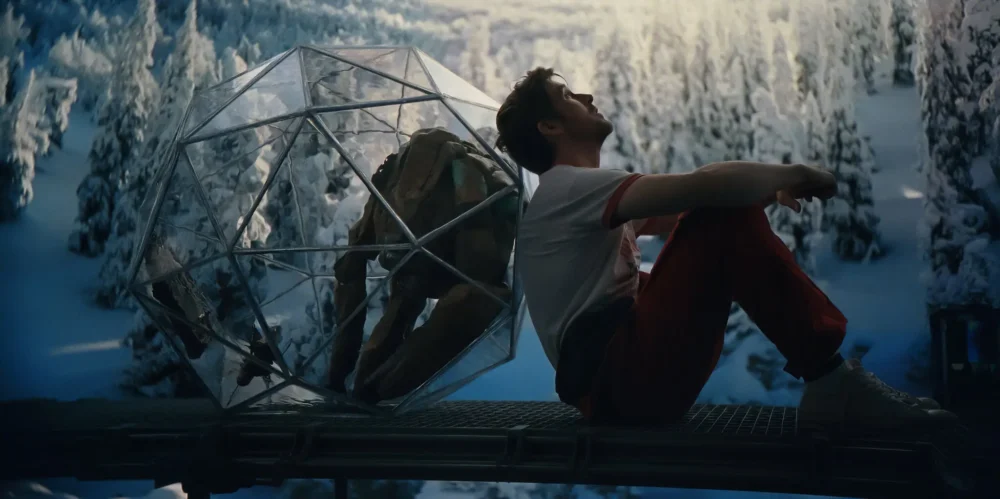
Counterfactual #2: In the far, far distant future, the accelerating expansion of the universe and the death of earlier generations of stars means that any intelligent life looking to the sky might see a sky much darker than ours. Dead stars, and galaxies that have slipped past the observable horizon.
But we live now, on a planet with an atmosphere sometimes crystal clear, our cheerful yellow sun shining through it and casting shadows. There is an infinite variety of pattern in the things we see in the sky. That cheerful sun appears to follow a daily path through the sky, a path that changes from day to day in a seasonal pattern and one that humans have watched with intense interest since before we were human. A vast expanse of pinpoint stars and colorful galaxies creates a unique, nearly unchanging pattern of the firmament. That beautiful pattern of light forms the backdrop to other fascinating sky objects – our constantly changing moon, our neighboring planets (and their moons, when we learned to see them), comets.
All of those objects – the sun, the moon, the planets, the stars – appear to move in an intricate pattern. The pattern defies a simple description: there is not an integer number of days in a year, or in the cycle of the moon’s phases; the planets move sometimes with the stars, sometimes against, and always shifting.
One could almost imagine our sky as a puzzle presented to humanity intended to inspire our curiosity and spur us on to trying to solve the mystery of those patterns.
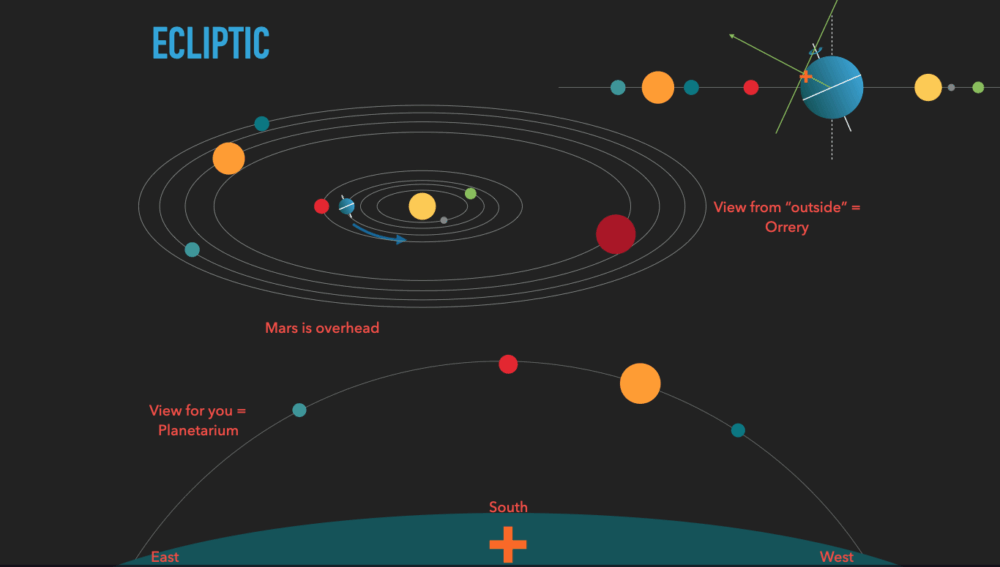
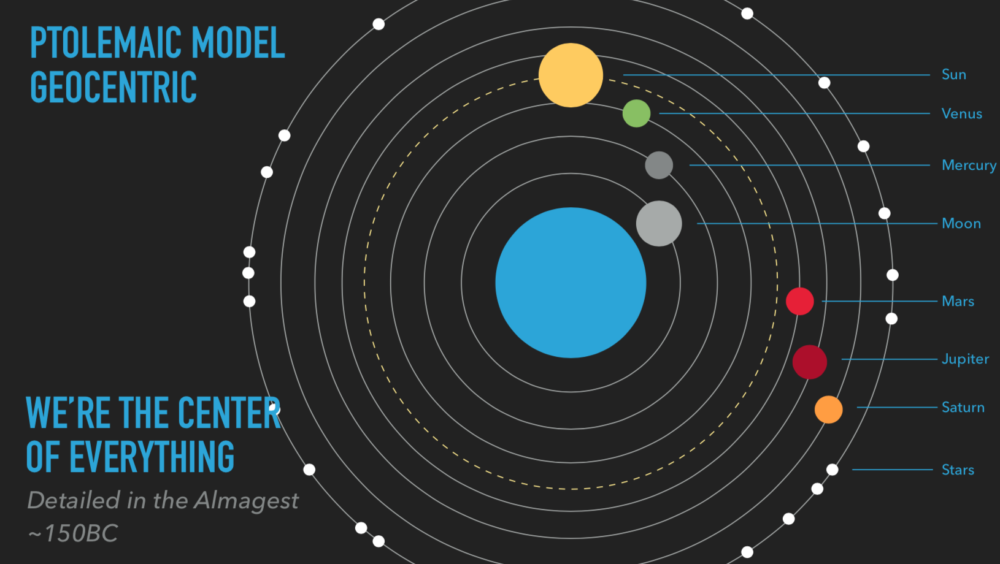
Why is this puzzle the way it is? Early in the class we will have an overview of some basic astronomy, inspired by Asimov’s early non-fiction book, The Clock We Live On. Later we might loop back to astronomy to discuss just how mind-meltingly gigantic the universe is, and our evolving understanding of that immensity. These are mostly in slide form for now, but I hope to outline them in more detail here soon.
Time’s Arrow & Time’s End
How could time end? Although a fundamental aspect of existence, time is impossible to isolate from the changing phenomena that mark its apparent passage. Of time, Einstein stated that “time is that which clocks measure”, and measurement requires an observable change. In one possible far future of the universe, maximum entropy is achieved and heat-death renders all differences between regions of space zero. Particles themselves decay, and no pocket of order remains in a sea of cold disorder. Change is no longer possible. When clocks cannot operate, time ends.
This progression from low-entropy order to high-entropy disorder, referred to as the “arrow of time”, has been proposed as the reason time seems to us to flow forward from past to future even while the underlying physics, when considered at a small enough scale, seem indifferent to which direction time goes.
Sean Carroll writes extensively and clearly about this, and the mystery of why entropy was low in the past (the Past Hypothesis).
Relativity and the Speed of Light
Do time and space exist independently of events and objects? Before Newton, various schools of thought went back and forth on this issue. However, Newton seemed to put the issue to rest. In his Principia, he declared “absolute, true, and mathematical” time and space exist separate from our relative, common understanding of them, which can only arise from perceptions of phenomena. Absolute space is the arena in which all things are placed, and absolute time is the true sequence and duration of events, regardless of how or if they are manifest as phenomena. Since Newton produced powerful results using these assumptions – the laws of motion that accurately describe the orbits of the planets (except Mercury, sort of… more on that later) – that seemed to settle the issue: Absolute time (and space) exists.
Two puzzles were bothersome, but no where near enough to throw out the result. Mercury’s motion seemed a bit weird – close to what Newton predicted but off just enough that it probably wasn’t a measurement error. All other planets seemed predicted perfectly.
Second puzzle: mass seems to manifest itself in two separate ways that just so happen to balance each other out. When gravity acts on a body, it does so in proportion to its gravitational mass and imparts a force on it resulting in an acceleration. Any acceleration, including gravity, is proportional to the force applied to a body and inversely proportional to its inertial mass. Thus, lead and wood fall at the same velocity – the attraction is greater for lead, but so is the inertia, so the resulting motion is the same. The coincidental equivalence of gravitational and inertial mass was troublesome.
Although Newton used his calculus to work out his theories, he presented the arguments in Principia geometrically (so as to be understandable to his contemporaries). The idea of pure, absolute time and space share an underlying similarity to Euclid’s conceptions of perfect idealized geometric concepts like a zero-dimensional point or a line with infinite length but no width – ideas that we could conceive of and reason with even though we never directly encounter them in reality.
Keep in mind that the term relativity already existed for Newton, from Galileo’s concept of the inertial invariance of laws of motion. It doesn’t matter if a ship is moving across the water relative to land, or a planet through space relative to the galaxy – a set of objects can share an inertial frame of reference, and laws relating to their motion apply. A ball dropped from a moving ship will appear to fall straight down from the reference point of the ship, as it would on land. The same ship-bound ball, when viewed from land however, will follow a curved path relative to a reference point of the shore because of the relative velocity between the frames. No problem.
Leading up to Einstein, we must note another development. The relationship between two seemingly separate forces was characterized by Faraday: Electricity and magnetism came to be seen as related aspects of the same fundamental force. This relationship was quantified by Maxwell’s equations governing electromagnetism.
However, there was a problem, which would become a defining problem in physics in the early 1900s: Maxwell’s equations (which, like Newton’s, have far-reaching explanatory power) insist that there is a fixed speed at which light propagates. Not in relationship to an observer, or an inertial frame of reference, but absolute. One interpretation was that this speed is relative, but to an as-yet-unknown medium, dubbed “ether”. Scientists began searching for evidence of the ether. (See the Michelson-Morley and Fizeau experiments.) No evidence of ether was found, yielding a null result that puzzled scientists at the time. Enter Einstein.
In 1905, railways were growing, and for the first time, people could move from point to point fast enough that the relative local times – based on solar noon at a precise location – become a problem. If a train is leaving village A at noon for town A, what time is it in town B, where it will arrive? Coordinating the movement of trains and clocks was a pertinent problem of the day. Einstein, working in a patent office, must have reviewed proposed solutions to coordinating time along railroad tracks. And he was puzzled by the null result for ether – why do all measurements of light seem to yield the same velocity, regardless of the motion of the observer?
in 1905, the so-called Annus Mirabilis, he published 4 papers, including on the Electrodynamics of Moving Objects. Using a geometrical argument, he took as granted that all observers will measure the same velocity for light regardless of their relative velocity, and rearranged space and time to account for different inertial frames, given the special case that those frames were moving relative to one another in a straight line at uniform velocity: Special Relativity. In short, as velocity increases, time slows down and space contracts in the direction of motion. Incorporating an idea from his teacher Minkowsky, Einstein simplified the geometrical equations with three spatial variables + time to a four-dimensional space where time has a imaginary component, known as the Lorentz transformation.
Another 10 years of thinking applied relativity to all forms of motion (accelerative/curved as well as uniform) and unified inertial and gravitational mass: General Relativity. This theory correctly predicted motion of Mercury, and that light would bend in a gravitational field. This leads to the notion of curved space time.
Some of the best resources on relativity (in addition to Einstein’s approachable paper, above):
Heisenberg Uncertainty
You might be familiar with the idea that a particle’s momentum and velocity are subject to Heisenberg uncertainty – knowing one more inherently means knowing the other less. The same is true for time and energy:
Further Topics
- Entropy, Maxwell’s Demon, and Meng Po
- Analemmas and the Equation of Time
- Presentism, Eternalism, and the Block Universe
- Sidereal and mean solar days
- Elevation and Azimuth
- Ephemerides
- Equinoctial
- International Atomic Time (TAI)
- The metonic cycle
- Superior highly composite numbers
Science Links
Over the years I’ve accumulated about a thousand time-related bookmarks. In 2026, I used Claude Cowork to scan the links, eliminate duplicates and dead ends, and place the remainder in organized categories following the six sections of the syllabus. These are from that process. While I found all these links originally, I haven’t reopened each link to see how Claude did… Spot checking so far seems like this is a valuable improvement, so I’m sharing on the syllabus.
General
- Astronomy: The Celestial Sphere — A diagram-heavy lecture page walking through how the sun, moon, planets, and stars appear to move across the sky and why eclipses line up the way they do.
- Daytime Moon: Seeing the Moon During the Day — Astronomer Phil Plait uses his own photos to debunk the common belief that the Moon is only visible at night.
- New Quantum Theory Could Explain the Flow of Time — A WIRED report on a proposed quantum-mechanical explanation for why time only seems to move in one direction.
- General Relativity Explained Like You’ve Never Seen Before — An illustrated, scroll-through explainer that uses Einstein’s “happiest thought” — falling off a roof — to show how gravity is really just warped spacetime.
- Physicists Reverse Time Using a Quantum Computer — Covers a real MIPT experiment that briefly ran a quantum computer’s state backward, testing the limits of the thermodynamic arrow of time.
- The Beginning of Time — Stephen Hawking’s own essay on how the universe, and time itself, began with the Big Bang.
- Cepheid Variable — Explains how these rhythmically pulsating stars let Henrietta Leavitt turn a star’s blink rate into a ruler for measuring the universe.
- Bell’s Theorem — Lays out the theorem and experiments proving quantum particles can’t be explained by hidden local variables — one of physics’ strangest results.
- The Fundamentals of Space-Time, Part 2 — CERN scientists animate a space-time diagram to show why light’s speed never changes, no matter how fast you’re moving.
- Simulating Planetary Orbits — A full working Python program that simulates the Sun, Earth, and Venus orbiting each other using Newton’s law of gravity.
- Video Map of Known Exoplanets — A one-minute time-lapse video charting every exoplanet discovery from zero in 1991 to more than 4,000 by 2019.
- Astronomy 10: Lecture 2 — UC Berkeley lecture notes covering constellations, the celestial sphere, and why Earth’s axial tilt — not its distance from the sun — causes the seasons.
- The Cosmic Distance Ladder — Mathematician Terence Tao’s illustrated slide deck retracing, rung by rung, how humans measured distance from Earth’s radius all the way out to the edge of the observable universe.
- It Took Centuries, But We Now Know the Size of the Universe — A BBC Earth history of how astronomers gradually pinned down the almost incomprehensible scale of the universe.
- Einstein’s Clocks: The Place of Time — A historian of science’s deep dive into how Einstein’s 1905 relativity paper grew out of the very practical problem of synchronizing clocks.
- The Physics and Philosophy of Time — with Carlo Rovelli — A Royal Institution lecture in which physicist Carlo Rovelli argues that the flow of time may be more a feature of human perception than of physics.
- Bayes’ Theorem: A Visual Introduction — A beginner-friendly site that uses Venn diagrams and decision trees to show how Bayes’ Theorem updates your beliefs when new evidence comes in.
- A Formal Solution to the Grain of Truth Problem — A theoretical computer-science paper proving that Bayesian agents can learn to predict each other’s strategies in multi-agent games.
- What Is Sidereal Time? — A step-by-step explanation of why astronomers track time by the stars instead of the sun, and how the two clocks slowly drift apart.
- The Universe’s Clock Might Have Bigger Ticks Than We Imagine — Reports on a new theory suggesting time itself might come in discrete “ticks” no smaller than a billionth of a billionth of a billionth of a second.
- The Oysters That Knew What Time It Was — A WIRED feature on oysters’ internal biological clocks and what they reveal about circadian rhythms in the ocean.
- Almagest Book II: Angle Between Ecliptic and Horizon Calculations — A modern astronomer works step-by-step through Ptolemy’s 2,000-year-old trigonometric method for locating the ecliptic in the sky.
- More Accurate Clocks May Add More Disorder to the Universe — Covers an experiment showing that the more precisely a clock ticks, the more entropy it must pump into the universe to do it.
- Astronomy by JavaScript: Sun Calculators and More — A toolbox of free browser-based calculators for sunrise/sunset times, solar declination, sidereal time, and equinox and solstice dates.
- A ‘Wobble’ in the Moon’s Orbit Could Cause Record Flooding in the 2030s — Explains how an 18.6-year wobble in the Moon’s orbit will combine with sea-level rise to trigger a surge in U.S. coastal flooding.
- Google May Have Achieved a Scientific Breakthrough: Time Crystals — Breaks down what a “time crystal” is and why Google’s quantum computer may have created a strange new phase of matter that repeats in time instead of space.
- The New Science of Clocks Prompts Questions About the Nature of Time — An in-depth feature on physicists’ discovery that every clock is secretly a heat engine, tying timekeeping accuracy to entropy and the arrow of time.
- FNET World-Wide Frequency Map — A live, real-time map of the alternating-current frequency of power grids around the world, tick by tick.
- FNET/GridEye Server Map Gradient Display — A real-time visualization of U.S. power-grid frequency data collected by UT’s FNET/GridEye sensor network.
- The Future of Astronomy, from the Webb Space Telescope to Gravitational Waves — A Vox explainer on what the James Webb Space Telescope can’t do, and what the next generation of telescopes and gravitational-wave detectors will need to pick up where it leaves off.
- Hansen’s Star Map and the Precession of the Equinoxes Circle — An amateur astronomer decodes how sculptor Oskar Hansen encoded the exact date and time of the Hoover Dam’s 1935 dedication into a celestial star-map built into its terrazzo floor.
- A Mechanical True Random Number Generator — A peer-reviewed physics paper on building a device that generates genuinely random numbers from chaotic mechanical motion instead of a computer algorithm.
- Dark Matter May Exist Because a Mirror Universe Is Running Backward in Time — Explains a physics proposal for a CPT-symmetric “anti-universe” running backward in time before the Big Bang, whose invisible right-handed neutrinos could be dark matter.
- Earliest Documented Aurora Found in Ancient Chinese Text — Researchers translate a 4th-century-BC Chinese bamboo text describing “five-colored light” in the sky around 977 BC, likely the oldest aurora sighting ever recorded.
- Get Ready for the New, Improved Second — Explains why scientists are preparing to redefine the official second using ultra-precise optical atomic clocks in place of today’s microwave cesium standard.
- Windfinder – Wind Map, Forecast & Weather Reports — A live, zoomable global map of real-time wind speed, wave height, and weather conditions for any spot on Earth.
- Seeing Time Through a Liquid Crystal Display — A physics puzzle column that builds a toy “LCD universe” simulation so readers can explore entropy, randomness, and why time’s arrow only points one way.
- Solution: ‘Time Through an LCD Display’ — Walks through the answers to Quanta’s LCD-universe puzzle, showing how “stratified stability” can make low-entropy order appear far faster than random chance alone.
- What Science Says About the Birth of the Universe — An On the Media audio segment on how the James Webb Space Telescope’s baby pictures of the cosmos are reshaping ideas about the universe’s origins.
- Carlo Rovelli on the Meaning of Time — A Financial Times interview with physicist Carlo Rovelli on his argument that the time we intuitively experience is largely an illusion of perspective.
- Scientists Puzzled Because James Webb Is Seeing Stuff That Shouldn’t Be There — Reports that JWST images show the universe’s earliest galaxies were surprisingly massive and well-formed, upending assumptions about how fast structure formed after the Big Bang.
- Video Shows the Heartbreaking Moment the Arecibo Telescope Collapsed — Raw and drone footage of the famed Arecibo radio telescope’s 900-ton platform crashing down in 2020, ending 57 years of scanning the skies for signals.
- The Unexpected Measure That Makes the Modern World Tick — A Be Smart video unpacking the surprisingly complicated science and history behind how we define and keep the second.
- ‘Time is Elastic’: An Extract from Carlo Rovelli’s The Order of Time — A book excerpt in which physicist Carlo Rovelli argues there is no single universal “now,” and that time flows differently depending on where you stand.
- Seven Brief Lessons on Physics by Carlo Rovelli — A free, full digitized copy of Rovelli’s bestselling primer on relativity, quantum mechanics, black holes, and the nature of time, readable or downloadable online.
- Trillionth-of-a-Second Camera Captures Chaos in Action — Describes a neutron-based imaging technique fast enough to catch individual atoms jittering out of place inside a material, motion no ordinary camera could ever freeze.
- The Blue Supermoon: Photos and What to Know — A photo roundup and explainer on the rare August 2023 “blue supermoon,” when a second full moon in one month coincided with its closest approach to Earth.
- Is the Future Real? The Philosopher’s Guide to Time Travel — A podcast episode pairing a time-machine-designing physicist, a philosopher of time, and sci-fi writer Ted Chiang to debate whether the past and future are as real as now.
- Long Period Pendulums — A physics professor’s catalog of clever mechanical tricks — folded pendulums, magnetic levitation, crossed-wire suspensions — engineers use to build extremely slow-swinging pendulums for seismometers and gravity measurements.
- Cicada Maps 2024: Where Two Broods Are Emerging — Interactive maps tracking the rare 2024 double emergence of two periodical cicada broods on their 13- and 17-year clocks, a pairing that last coincided in 1803.
- World’s Most Accurate and Precise Atomic Clock Pushes New Frontiers in Physics — NIST and JILA’s strontium optical-lattice clock is precise enough to detect Einstein’s general relativity effects on time across a distance thinner than a human hair.
- Moon — An interactive, scroll-driven explainer with live 3D models letting you manipulate the Moon’s orbit, phases, libration, and tides to see exactly why each one happens.
- If We Want to Live on Other Worlds, We’re Going to Need New Clocks — Covers a NASA JPL proposal for a standardized lunar time system, since clocks on the Moon’s surface run about 56 microseconds faster per day than clocks on Earth.
- Lee Smolin Public Lecture: Time Reborn — A Perimeter Institute public lecture in which physicist Lee Smolin argues time is real and fundamental, not the illusion that physics’ “block universe” models suggest.
Solar System Simulators & Orbital Tools
- Locate Voyager 1 in the Sky (Online Planetarium) — Interactive star map that plots Voyager 1’s real-time position, rise/set times, and distance from Earth against the night sky from any location.
- Solar System Live — Generates a customizable orrery image of the planets for any date, viewpoint, and coordinate system you choose.
- The Planets Today: A Live View of the Solar System — Plots real-time planet and dwarf-planet positions on an orrery you can spin between a neat diagrammatic view and true elliptical orbits.
- Interactive Star Map and Virtual Sky (Planetarium) — Redirects to Stellarium Web, a browser-based planetarium that renders a realistic naked-eye view of the night sky for any time and place.
- Heavens-Above — Predicts exactly when and where to spot the ISS, Starlink trains, and other satellites passing over your location, plus live sky charts.
- Southern Stars — Maker of Orbitrack, an app that tracks thousands of orbiting spacecraft and alerts you when they’ll pass overhead.
- Online Planetarium — Interactive sky map showing which stars, planets, and satellites are visible from your location right now.
- 3D Solar System Simulator — Lets you spin and zoom through a 3D model of planet, asteroid, and comet orbits at any date between 1900 and 2100.
- Solar System Map — Diagrams every planet and dwarf planet in order from the Sun with its size, mass, and orbital period, plus links to true-to-scale distance maps.
- Planet’s Position on Ecliptic and Equatorial Planes Calculator — Crunches a planet’s ecliptic longitude/latitude and right ascension/declination for any date between 1900 and 2099.
- astronomy.js — Open-source JavaScript engine that computes planetary positions, powering several other orrery tools on this list.
- Solar System Calculator — Live demo that lists every planet’s real-time rise/culmination/set times, coordinates, and distance from your chosen location.
- 3D Diagram of the Solar System — Renders a rotatable 3D diagram of the planets’ current positions and orbits around the Sun.
- Simulator: Online Revolution Orbits of the Planets — Flies you through a 3D animation of the planets orbiting the Sun, with controls to speed up time and toggle the asteroid belt, Kuiper belt, and habitable zone.
- Heliospheric Planet Coordinates — NASA tool that outputs raw heliocentric trajectory data for planets, comets, and dozens of spacecraft over a chosen date range.
- Where Can I Get the Position of the Planets by a Specific Date? — A crowd-sourced Quora thread pointing to tools and calculators for looking up planetary positions on any given date.
- Interactive Sky Chart (with PDF Print Option) — Builds a customizable star chart for your date, time, and location, toggling constellation lines and the ecliptic on or off, and exportable as a PDF.
- If the Moon Were Only 1 Pixel — An endlessly scrolling, to-scale map of the solar system that makes you feel just how much empty space separates the planets.
- Solar System Info Page — A deep-dive reference hub with sliders for your weight and age on other worlds, plus links to a dozen other orrery and simulation tools.
- Solar System Simulator — NASA’s writeup of jsOrrery, an open-source 3D simulator for visualizing planet and spacecraft positions and phenomena like retrograde motion.
- Solar System Live (Alternate URL) — Alternate address for Fourmilab’s classic customizable orrery generator, producing a solar system view for any date and vantage point.
- jsOrrery – JavaScript Solar System Simulator — Open-source WebGL orrery that lets you pick a date, camera viewpoint (including standing on any planet), and playback speed to watch the solar system move.
- Keplerian Elements for Approximate Positions of the Major Planets — NASA JPL’s reference table of orbital elements and rates you can plug into Kepler’s equations to compute any planet’s position for a given date.
- Frequently Asked Questions — JPL’s Solar System Dynamics group answers common questions about ephemerides, coordinate systems, and orbital mechanics terminology.
- Julian Day Calendar — A NASA reference tool for converting between calendar dates and the Julian Day numbers used in astronomical calculations.
- Computing Planetary Positions: A Tutorial with Worked Examples — Paul Schlyter’s classic hand-calculation walkthrough for finding orbital elements and converting them into sky coordinates, step by step.
- Transfer Orbits for Dummies! A Hillbilly Tutorial — A plain-English forum explainer that breaks down semimajor axis, eccentricity, and Hohmann transfer orbits without the jargon overload.
- Altitude / Azimuth of Solar System Bodies — Japan’s National Astronomical Observatory tool that calculates the sky position (altitude and azimuth) of the Sun, Moon, planets, and dwarf planets for any place and time.
- HORIZONS System — JPL’s on-demand ephemeris generator that produces high-precision positions and velocities for virtually any solar system body from any observing location and time.
- Python API for JPL Horizons? — A Stack Exchange thread rounding up Python libraries and wrappers for pulling ephemeris data straight from JPL’s Horizons system.
- stellarium-web-engine: JavaScript Planetarium Engine — The open-source WebGL engine behind Stellarium Web, rendering over a billion Gaia-catalog stars, atmospheres, and planet textures in the browser.
- NOAA Solar Position Calculator — Enter a date, time, and location to get the Sun’s exact azimuth, elevation, and declination from NOAA’s classic solar calculator.
- SunCalc: Sunrise, Sunset & Sun Position Calculator — An interactive world map that plots the Sun’s daily path, twilight phases, and shadow lengths for any spot you click.
- How to Create Your Own Solar System Simulator with JavaScript — A five-part, under-500-line coding tutorial that builds a working planetary orrery from a blank HTML canvas using Keplerian elements.
- International Space Station Orbit Tracker — A Practical Engineering video demonstrating how to track and visualize the ISS’s real-time orbit around Earth.
- How To Track Satellites In Space With a $35 Computer — The story of Satelliten, a Raspberry Pi-powered drawing machine that inks real-time satellite paths onto old paper maps.
- Stellarium Web Online Star Map — A full planetarium in your browser, rendering a realistic naked-eye, binocular, or telescope view of the sky from any location and date.
- NASA/JPL Eyes Orrery — A 3D interactive orrery view within NASA’s Eyes app that lets you fly around Earth and the solar system in real time.
- Eyes on the Solar System — NASA/JPL’s 3D visualization tool for exploring planets, moons, and spacecraft trajectories across past and future missions.
- Planets of Our Solar System — A planet-by-planet reference covering size, orbit, atmosphere, and exploration history, paired with a live-updating map of current planet positions.
- Approximate Positions of the Planets — JPL’s formulas and Keplerian element tables for hand-calculating low-precision planet positions across a 6,000-year time span.
Relativity & Physics of Time
- Massive U.S. Machines That Hunt for Ripples in Space-Time Just Got an Upgrade — Reports on LIGO’s 2019 hardware overhaul, which was expected to roughly double the twin detectors’ ability to sense colliding black holes and neutron stars.
- On the Electrodynamics of Moving Bodies (Einstein’s 1905 Relativity Paper) — An English translation of Einstein’s original 1905 paper, the one that derives special relativity — Lorentz transformations, time dilation, and the death of absolute simultaneity — from just two postulates.
- On the Electrodynamics of Moving Bodies (Einstein’s First Relativity Paper) — A second hosted copy of Einstein’s founding 1905 special relativity paper, translated into English.
- The 1905 Relativity Paper and the “Light Quantum” — A historian of science shows how Einstein’s relativity paper quietly built in the same energy-frequency transformation law as his light-quantum hypothesis, without ever mentioning quanta.
- These Super-Precise Clocks Help Weave Together Space and Time — Profiles the ultra-precise atomic clocks being networked together to detect the tiny relativistic time differences caused by Earth’s gravity and motion.
- Two Broken Satellites Will Make the Most Precise Test of General Relativity Yet — Tells how two Galileo navigation satellites accidentally launched into the wrong orbit turned into an unplanned, highly precise test of gravitational time dilation.
- Einstein’s General Relativity Theory Beginning to Fray at the Edges — Reports that UCLA astronomer Andrea Ghez’s 24-year study of a star’s full orbit around the Milky Way’s central black hole confirms general relativity, even as she flags its limits at the event horizon.
- The Illusion of Time — A review of Carlo Rovelli’s book “The Order of Time,” which argues that our felt sense of a single flowing “now” dissolves once physics is examined closely.
- The Nature of Time — Julian Barbour’s prize-winning essay arguing that duration isn’t fundamental at all, but emerges from timeless correlations between changing configurations of the universe.
- Clockwatcher: A Review of Julian Barbour’s “The End of Time” — A New York Times review unpacking physicist Julian Barbour’s claim that time doesn’t exist and that reality is really a landscape of static “time capsule” configurations.
- A Brief History of the Speed of Light — Walks through two millennia of attempts to measure light’s speed, from Galileo’s failed lantern experiment to Michelson’s mirrors and Einstein’s constant c.
- Special Relativity — An interactive, problem-based course that walks from Einstein’s postulates through Lorentz transformations and time dilation to E=mc² and relativistic energy-momentum.
- Time Might Be a Mirage Created by Quantum Physics, Study Suggests — Covers a 2024 theoretical study proposing that time isn’t fundamental but emerges from quantum entanglement between a system and a “clock,” via the Page-Wootters mechanism.
- Are Space and Time Interchangeable? — A crowd-answered physics Q&A on why time can’t simply be treated as a fourth spatial dimension, since the minus sign in the spacetime metric makes it behave fundamentally differently from space.
- The Real Reason You Can’t Go Faster Than Light Speed — Argues the textbook “mass increases to infinity” explanation for the light-speed limit misses the real point: every object moves through spacetime at a fixed rate, split between space and time.
- Time Isn’t Simply Just Another Dimension — Explains why time, despite being woven into four-dimensional spacetime, is not just a fourth version of a spatial direction and behaves in a fundamentally different way.
- Lecture Notes on General Relativity — Sean Carroll’s free, complete graduate-level lecture notes on GR, covering everything from spacetime and curvature to black holes, gravitational waves, and cosmology.
- Special Relativity: Clocks and Rods — Uses a simple “light clock” thought experiment to derive, step by step, why moving clocks run slow and moving rods contract in special relativity.
GPS & Satellite Timing
- GPS.gov: Timing Applications — Official GPS.gov page explaining how the atomic clocks aboard GPS satellites broadcast free precision time used to synchronize power grids, cell networks, and financial transaction timestamps worldwide.
- List of GPS Satellites — A continuously updated Wikipedia table cataloguing all 83 GPS satellites ever built, with launch dates, rocket, block type, SVN/PRN numbers, and current operational status.
- GPS Surpassed by BeiDou in China — A 2017 Geospatial World news brief reporting that China’s homegrown BeiDou navigation system had overtaken GPS in domestic chip market share and industrial output value.
- Sharper GPS Needs Even More Accurate Atomic Clocks — A physicist’s Conversation op-ed on how onboard atomic clock drift caps GPS position accuracy at a few meters, and how new ytterbium optical lattice clocks could shrink that error.
- GPS Network Time Synchronization — A Masterclock vendor guide contrasting NTP and PTP timing protocols and explaining how GPS satellites’ onboard atomic clocks serve as the master time reference for synchronizing computer networks.
- Time & Frequency Activities — A Naval Research Laboratory conference slide deck detailing GPS satellite atomic clock technology, on-orbit clock life testing, and development of the next-generation GPS timescale.
- GPS IIR Rubidium Clocks: In-Orbit Performance Aspects — A defense technical report analyzing the in-orbit frequency stability and projected operational lifetimes of the rubidium atomic clocks flown aboard GPS Block IIR satellites.
- Indian Regional Navigation Satellite System — Wikipedia’s technical rundown of India’s NavIC regional satellite navigation system, covering its signal structure and the repeated onboard atomic clock failures that have degraded its accuracy.
- Owners of Old iPhones and iPads MUST Update Their Software Before Sunday — A Daily Mail news report warning that the 2019 GPS week-number rollover would break location and timing features on unpatched older iPhones and iPads.
- Orbit Pavilion — A NASA JPL-designed shell-shaped outdoor sound installation at The Huntington that translates the real-time orbital passes of the ISS and 19 Earth-science satellites into distinct sounds.
- Tracking the Satellites That Keep Us on Track: Monitoring GPS, Galileo, BeiDou, and GLONASS — A Hackaday writeup on an open-source project that uses off-the-shelf receivers to publicly monitor the ephemeris, health, and atomic-clock timing of every satellite in the GPS, Galileo, BeiDou, and GLONASS constellations.
- Starlink: How SpaceX’s 12,000-Satellite Internet Network Will Work — A Business Insider explainer on the engineering behind SpaceX’s planned 12,000-satellite Starlink constellation designed to beam broadband internet to the ground.
Lunar Timekeeping
- What is a Lunar Month? — Reference page breaking down the 29.5-day synodic month, why lunar months vary in length, and includes a full year-by-year lunar calendar table.
- We Need Moon Standard Time — News article on ESA’s push for a shared lunar reference clock so Moonlight satellites and Artemis missions can communicate and navigate together.
- Telling Time on the Moon — ESA feature detailing the technical fight to define lunar time, including the fact that clocks on the Moon run about 56 microseconds faster per day than on Earth.
- Make a Moon Phases Calendar and Calculator — NASA/JPL classroom activity for building a paper wheel calculator that predicts the Moon’s phase and rise/set times for any date.
PBS Space Time (YouTube)
- How Special Relativity Makes Magnets Work — Video walkthrough of how magnetism emerges as a relativistic side effect of moving electric charges.
- Time Crystals! — PBS Space Time journal-club episode dissecting the physics papers behind time crystals, a phase of matter that repeats in time instead of space.
- The Origin of Matter and Time — PBS Space Time episode on how matter and the arrow of time itself emerged in the earliest moments after the Big Bang.
Maxwell’s Equations
- Maxwell’s Equations — Clickable tutorial site that breaks down all four of Maxwell’s equations (Gauss, Faraday, Ampere) term by term with minimal math.
- Maxwells-Equations.com Presents: Maxwell’s Equations — Companion video to the maxwells-equations.com site, walking through the four equations intuitively.
- Maxwell’s Equations: Crash Course Physics #37 — Crash Course Physics episode introducing Maxwell’s four equations and how they unify electricity and magnetism.