What we make for time
The world of ingenious timekeeping machines is incredibly diverse and inspiring. There is a technological lineage stretching back literally thousands of years that connects ancient machines like the Antikythera mechanism to today’s computers. There also is a level of craftspmanship that seems to emerge when makers contemplate time. Even the simplest sundial implies a maker atuned to subtle patterns in the world. There are no sloppy clocks (although there can be “bad” ones….).
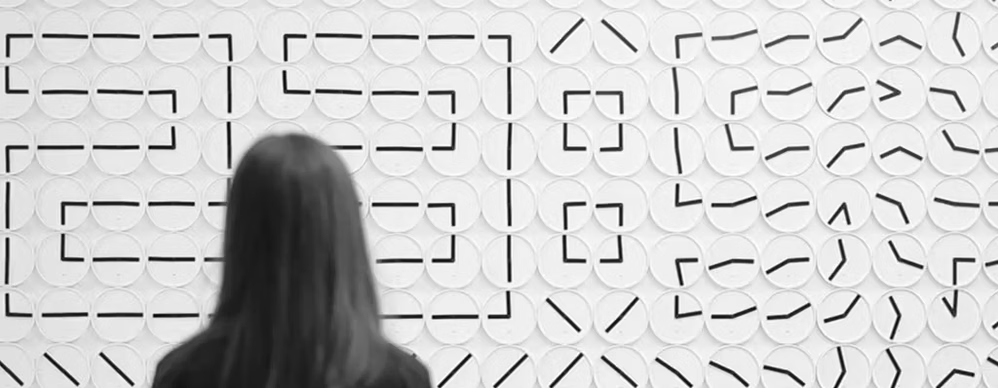
Sundials
The source of knowledge
A sundial casts a shadow that moves as the earth moves. The shadow casting “thing” (a stick in the ground, a triangular plate, etc) is called the “gnomon”, a word with origins in the Proto Indo-European language’s root “gno”, “to know”. To study the shadow is to study the world.
Sundials can be as simple as a stick in the ground, as with the oldest known, the Taosi Gnomon from Xiangfan, 1900BCE, or as elaborate as the monumental instruments at Uraniborg, Jantar Mantar, or Guguanxiangtai. There are many types, including horizontal, vertical (facing any direction, including north), equatorial, polar, and analemmatic sundials. They can tell “temporary” hours when every sunlight period is divided into the same number of parts (usually 6 before and 6 after the noon meridian), yielding long winter hours and short summer hours; or “vulgar” hours, as we generally do now, dividing each mean solar day into equal segments (24). They may or may not include adjustments for the Equation of Time (see also here and extensively here). If your home has a window that receives direct sunlight, your home is a kind of sundial. If any star were bright enough to cast a shadow, there might be sidereal dials; the moon can, sometimes, and there are moondials.
You are a quick google search away from finding countless templates and sundial generators. To get you started, here is a traditional horizontal dial generator and one for vertical dials; several more are listed in the section on software tools on this site.Aidan Fowler’s dichroic sundial for Time 02020 changes color throughout the day.

Astrolabes, armillary spheres, orreries, planetaria and astraria, volvelles, and heliostats are all related to sundials (isn’t this vocabulary great!!). Extending our metaphor, anything that changes in relation to another phenomenon, and calls attention to, magnifies, or delineates that change is a cousin to the sundial. The phenomena could be natural or synthetic, universal or personal.
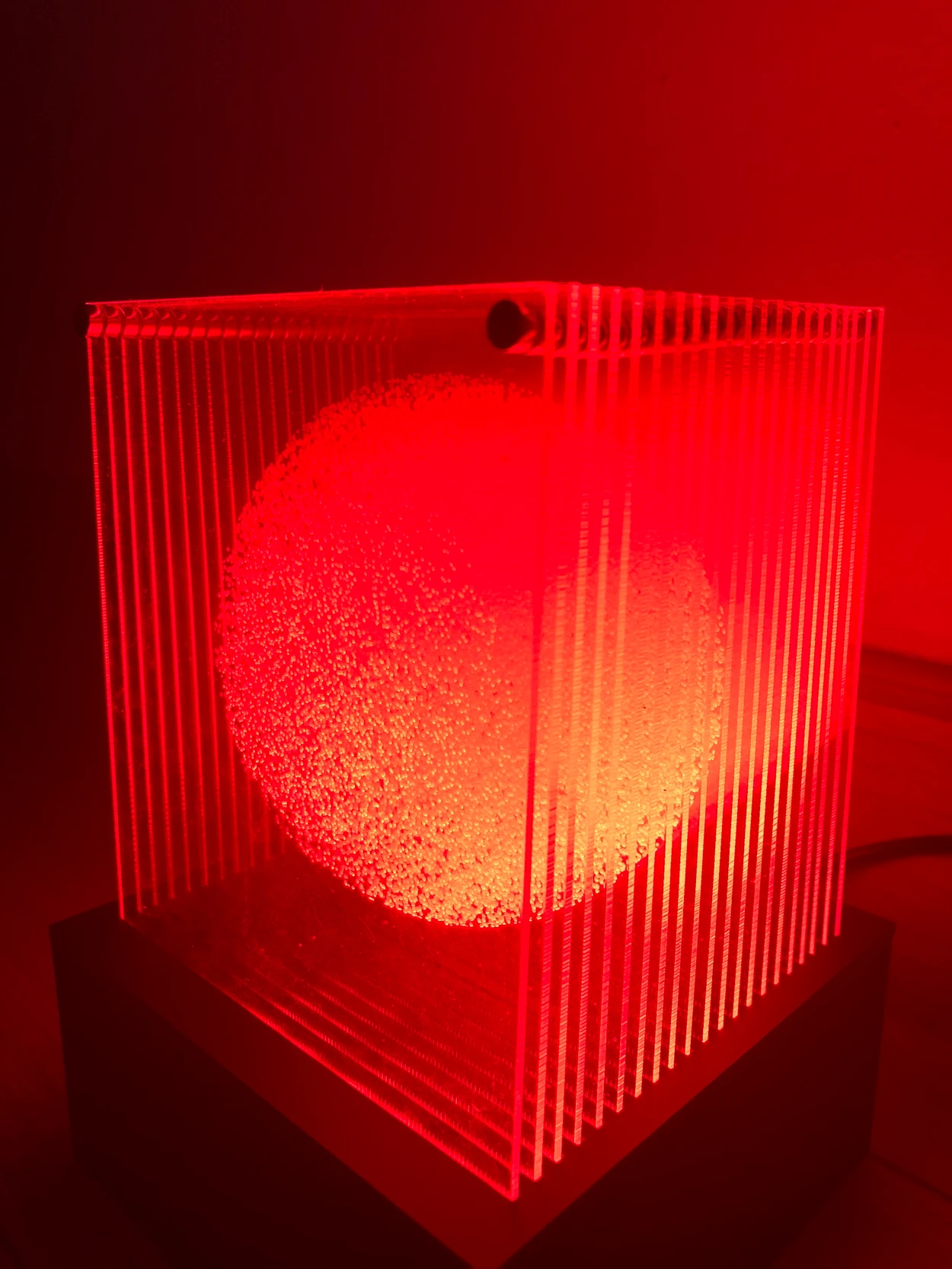
Jattuporn’s Red Moon – a moondial? Source
An Ancient Calculator
In 1901 an unremarkable hunk of corroded metal and rotted wood was recovered from a sunken shipwreck off the island of Antikythera, Greece. It had been on the ocean floor for nearly two thousand years, and it would remain largely unexamined until 70 years later, when advances in X-ray and gamma imaging would expose previously unimagined internal detail to the device now known as the Antikythera Mechanism. The images revealed complex clockwork (with comments in the code!), eventually understood, after much deduction, to be a kind of mechanical analog computer for tracking the passage of time. Hands indicated the position of the sun, moon and planets, as well as the moon’s phase, and a special section was dedicated to the schedule of the Olympic Games. Whatever fabrication techniques and mathematics the device embodied were lost to the ages – no known object approaching its intricacy would appear in the world for another 1000 years.

The Antikythera Mechanism is an almost unbelievable anachronism, like finding an airplane in an ancient tomb. Yet at the time it was made, it already represented the heritage of thousands of years of human curiosity about the passage of time. This curiosity spans cultures, and was present when our earliest ancestors learned to find patterns in the seasons, the migrations of animals, the tides, the apparent motions of stars and planets and the moon across the sky. Mathematics developed to describe and generalize these patterns, allowing early humans to make vital predictions; tools were invented that reflected the mathematics in mechanisms to assist those prehistoric scientists; skills to make and use those tools were passed from generation to generation. How many other mechanisms like the Antikythera were invented and lost and invented again? Reflecting on the nature of time connects us to a vast human enterprise that stretches from the first glimmers of reason to our highest achievements.
Further reading: The Smithsonian, Nature, University College London video
Ratios, Rates, and Resonance
The Antikythera Mechanism is not a timekeeper per se. It has no automatic drive moving it forward at a set rate, but rather, an operator provides an input through a crank. It doesn’t matter if the crank is turned fast or slow, the purpose of the machine is to maintain a precise set of ratios between the motion of the crank and changes in position of various indicators on the front and back of the device. The Antikythera mechanism encodes a program mapping an input to an output, and this program can run at any speed. Time keepers have to run at the speed of the universe (1 second per second as per Carroll).
Early timekeepers relied on naturally occurring oscillations such as the daily motion of the sun across the sky to track time. A simple stick set in the ground becomes a ‘gnomon’, the shadow casting element of a sundial, from which much about the daily and yearly motion of the sun can be learned (‘gnosi’ is the Proto-Indo-European root for ‘knowledge’). The west-to-east motion of the shadow from dawn to dusk marks the temporal, variable hours of the day. Each day the shortest shadow occurs at local apparent noon, midway from sunrise to sunset, when the sun is highest above the horizon; but this shortest noon shadow also changes through the seasons, lengthening (in the Northern hemisphere) from the base of the gnomon in the winter when the sun is low, and contracting as the sun peaks higher in the summer sky.
The first artificial timekeepers relied on the steady flow of a process to mark time. A ‘clepsydra’ or ‘water thief’ is simply a container of water that leaks at a predictable rate; markings can show the passage of time by how much water has been lost. Similarly candles or incense sticks that burn at a predictable rate (determined perhaps by comparison to a sundial) can be used to mark time.
An important advance was made around 725AD by the Tang dynasty astronomer Yi Xing (行) (683–727AD). He is credited with developing the first escapement, where the continuous flow of water in a water-wheel clock was checked and quantized into discreet steps. This concept was also used in the famous astronomical clock tower of Su Song (苏颂) (1020-1101AD), which turned a model of the heavens in real time. In each mechanism, the drive wheel was designed such that it was locked in place until enough water filled a vessel and unlocked the wheel for a single step. This transformed the continuous variable of the rate of flow of water over a wheel into discreet, countable steps.
The modern timekeeper architecture would be complete once an energy source and an escapement was combined with an oscillator. Pendulums, sprung masses, crystal vibrations, and the movement of atoms themselves have all been harnessed to track time.
Large phenomena, like the revolutions of a planet about its star, are usually also slow. Nature’s most ephemeral, fastest oscillations make the most precise, and potentially universal, references for clocks. The four Pioneer and Voyager space probes, launched by NASA in the 1970s, contain a depiction of time intended to be understood by any intelligence the probes might, however unlikely, encounter. They depict an atom of hydrogen, the most abundant element in the universe, undergoing a spin-flip transition of its electron:
“The spin-flip transition of a hydrogen atom’s electron has a frequency of about 1420.405 MHz, which corresponds to a period of 0.704 ns. Light at this frequency has a vacuum wavelength of 21.106 cm (which is also the distance the light travels in that time period). Below the symbol, the small vertical line—representing the binary digit 1—specifies a unit of length (21 cm) as well as a unit of time (0.7 ns). Both units are used as measurements in the other symbols.[4]” Wikipedia
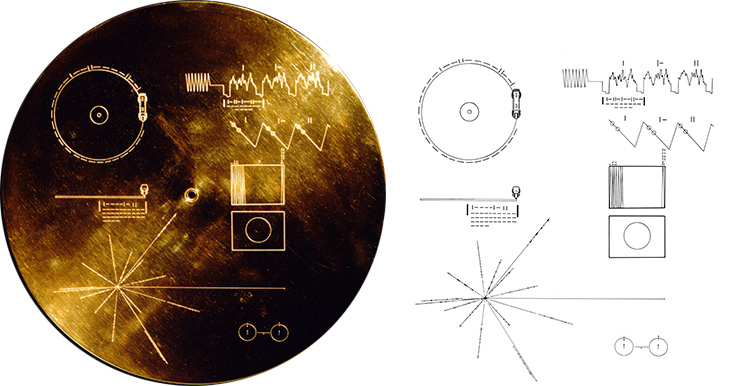
This unit of time, 0.704 ns, is used as the basis of a binary representation of time elsewhere in the symbols engraved on the probes. The solar system’s location in the galaxy is given by its relationship to 14 pulsars, identified by their precise periods using this binary notation, and on the Voyager records, the method for decoding their time-based signals also uses this notation. These probes are the first human-made objects to leave the solar system, and will continue until the end of time (if undisturbed) traveling across a universe defined in light-years, or the length light can travel in the time the Earth completes one revolution around its star.
Escapements
All hail the escapement
The ingenuity of mechanical timekeepers lies in the interface between an oscillator (like a pendulum) and source of energy (like a falling weight). All mechanical clocks have something that can periodically halts and resume the flow of energy in a subtle way called the escapement, regulating and converting a flow into a count.
The escapement acts as a trigger mechanism that locks the gear train of the timekeeper until a small movement from the oscillator unlocks it momentarily. This allows the gear train to advance one step, whereupon it is immediately re-locked by the escapement. At this happens, a small amount of energy from the energy source is transferred to the oscillator, giving it a kick that keeps it running. Without the oscillating timer and escapement, the energy source would simply and rapidly unwind, driving the display forward at an unregulated maximum speed.
Before I proceed, I should direct you to some beautiful visual representations of how watches and clocks work. The best I’ve seen is Bartosz Ciechanowski’s in-depth interactive about watches (worth looking at for the virtuosic JS coding alone – check under the hood, it’s nuts!).
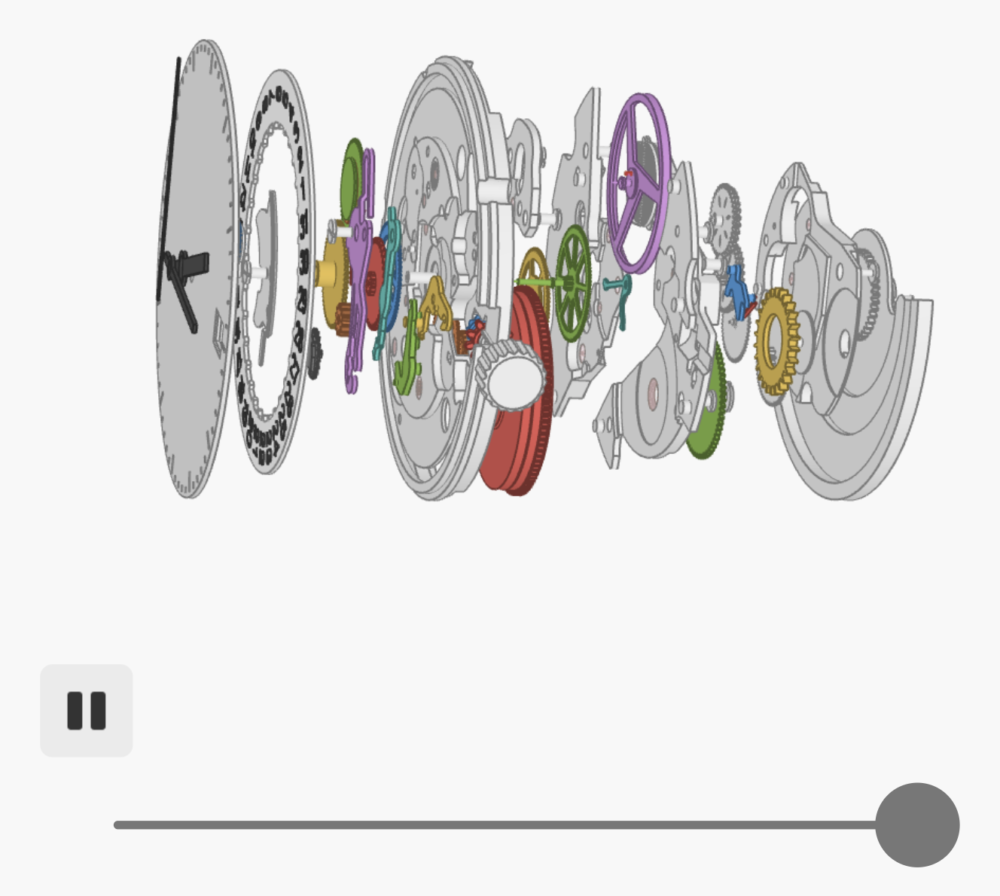
Hodinkee’s Watch 101 is also excellent. This 1949 video [https://www.youtube.com/watch?v=rL0_vOw6eCc] from the Hamilton Watch Company is both an interesting anachronism and a clear visual explanation using oversized mechanical models and stop motion; this more recent CG video [https://www.youtube.com/watch?v=9_QsCLYs2mY] is more concise.
The energy source is usually a descending weight or wound spring, although effects as subtle as barometric pressure changes have been harnessed.
The display is typically one or more hands indicating at least the hour, and maybe minutes and seconds too. The display is coupled to the energy source through gears (called wheels in horology). While these are ingenious and fabricated to amazing precision at a tiny scale, their function is relatively simple – to convert pulses from the escapement into the correct representation of the current time. Once you have a second hand revolving once per minute, it is a simple matter of gear 60:1 gear ratios to convert that to the minute hand movement, and again to the hour hand.
A huge variety of solutions to all aspects of timekeeping can be found in historical and current examples. While three hands (hours, minutes, seconds) is typical, other varieties abound: mecha-numerical displays, jumping indicators, retrograde indicators that reset after reaching an extreme, etc.
Engineezy has created a number of 3D printable escapements.
Watch Movements
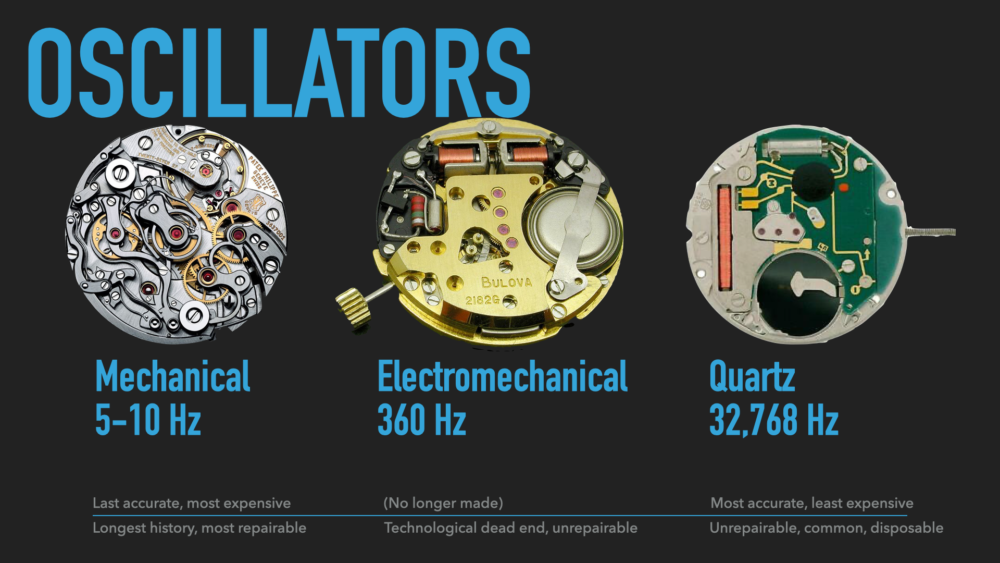
Two great animated/interactive resources:
Dial Design
Repetition and variation
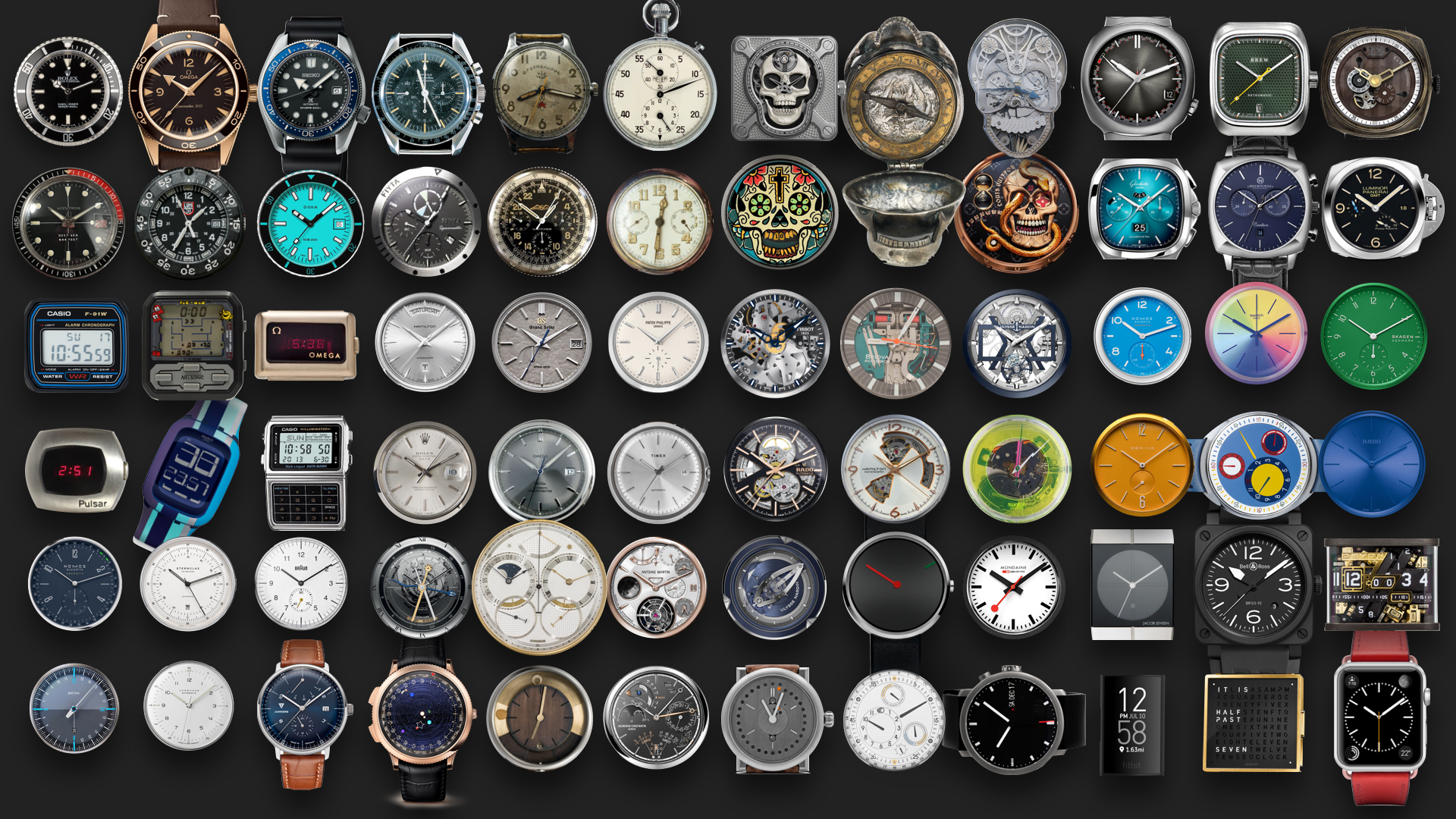
I don’t want the “Time” course to be just about cool consumer watches and clocks. But dammit, they are cool! And they have a place at ITP as excellent examples of information- and industrial-design. A watch* is a wearable machine (made to incredible precision) for displaying information. What info and how is worth studying, and if we look at the world of watches we have decades of fascinating examples of how this highly constrained problem is solved. The watch industry is also an example of slowly-evolving high/low technology. Traditional watch makers almost put themselves out of business by inventing quartz movements, but have remained viable through marketing/fetishizing less accurate but more romantic mechanical movements.
(*Clocks are also interesting for many of the same reasons, but since they don’t need to be wearable, they have fewer constraints and so wider design solutions at many different scales. Watches must be small enough to be worn and tough enough to keep accurate time while being banged around.)
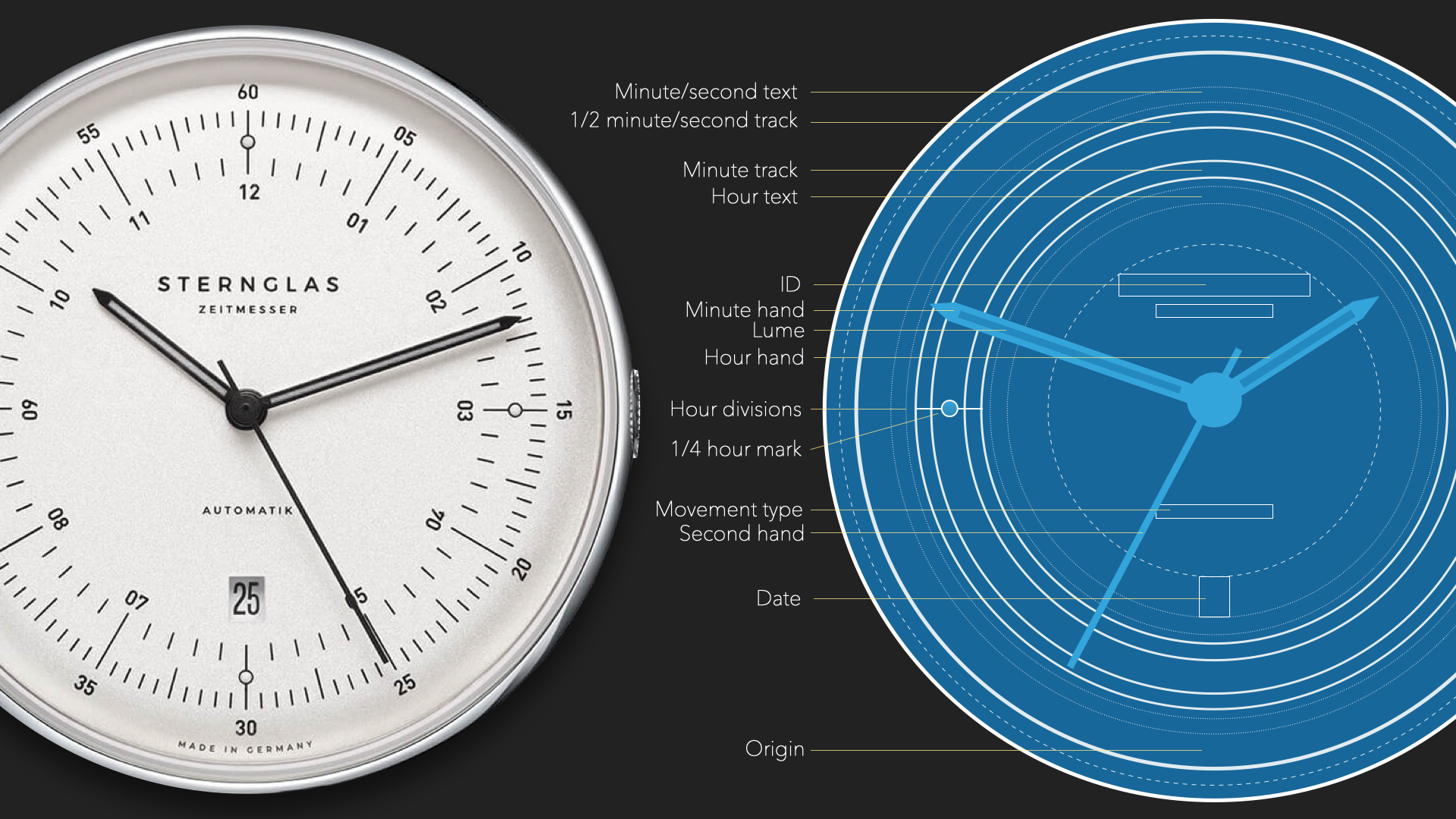
Edward R. Tufte, in his 1990 book Envisioning Information, introduces the concept of “small multiples.” In this data visualization technique, many variants of a dataset are arrayed together in a single image field, allowing easy comparison and contrast between sets. “Small multiples reveal, all at once, the scope of alternatives, a range of options.”
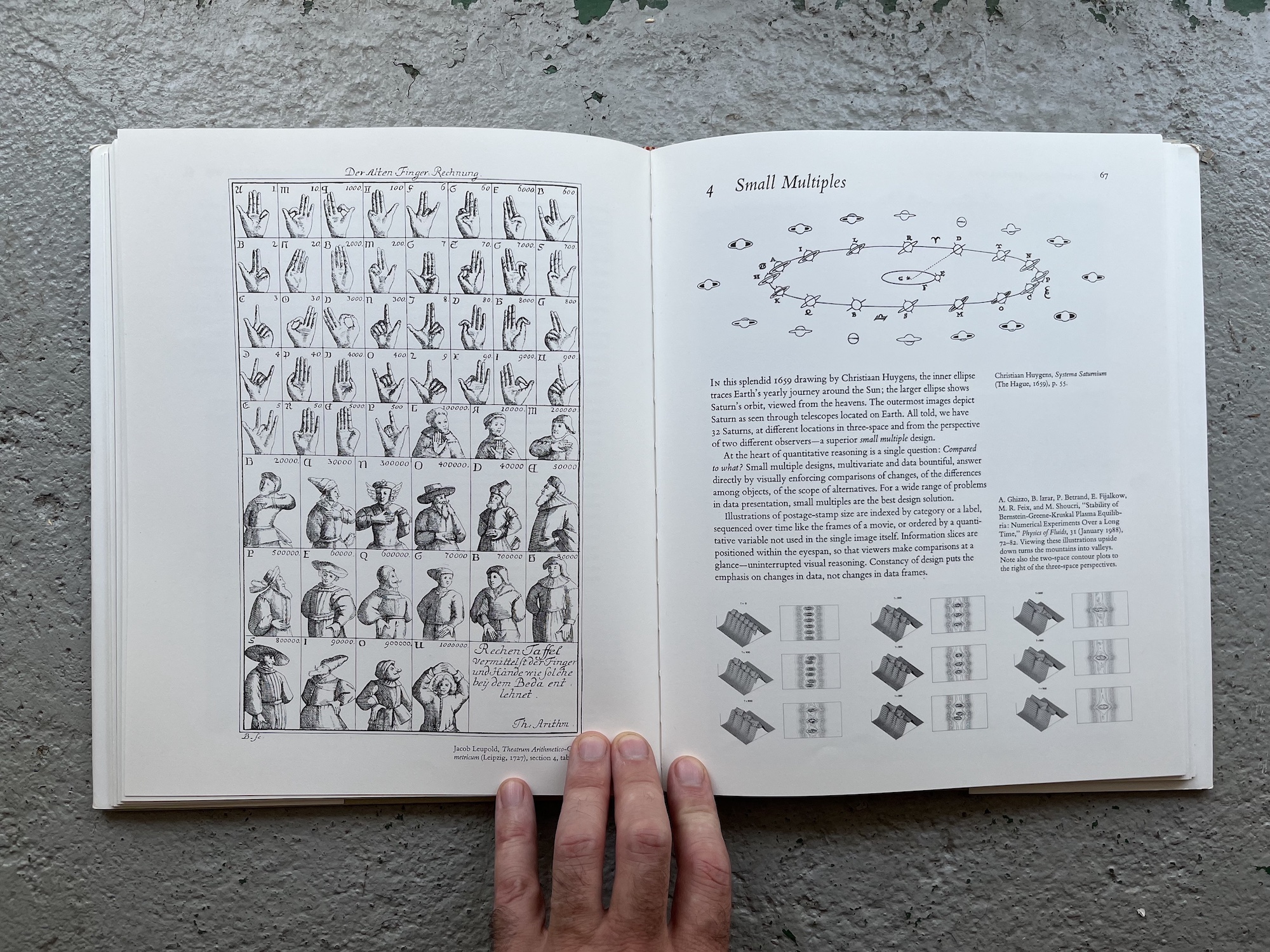
To me, small multiples are uniquely satisfying. It feels comforting survey an entire landscape at once, able to mentally zoom into neatly compartmentalized details. To the extent that I have a “collector impulse”, I suspect this has something to do with it: it is interesting to me to understand the total scope of something – say, electric guitars – and understand how each particular example fits into the whole (“Les Pauls are like this, while Fenders are like this”). Perhaps others feel the same.
Watch face design yields excellent small multiples. Each design attempts to solve the same problem: present the time legibly in a constrained space. Many (but not all!) arrive at a circular or near-circular design, a natural consequence of a rotation-based mechanism tracking daily cycles. Many (but not all!) use two or three hands around a central pivot, with typical (but not universal) features distinguishing the various hands (hour hand is shorter and wider than minute hand, for example). Dials and the markings on them exhibit a huge variety of color, texture, and proportion. Beyond the basic hours, minutes, and seconds, many watches include complications such as date, day of the week, month, lunar cycle, and more.
All of this assumes that the purpose of the watch is to tell the literal time – how many seconds have elapsed since midnight. Since the literal time is so abundant today as to be a cheap commodity (not always at all the case), artists working with clock-like objects often explore what I think of as “Bad Clocks” – clocks that attempt to speak to some aspect of time – psychological, cultural, personal – beyond the simply literal.
And further, this discussion so far ignores the internals of the watch (the “movements”, which themselves have a fascinating variety and history, more on that elsewhere). But confining ourselves to the external appearance of a watch, there is endless variety to explore.
Complications
In horology, anything beyond the basic function of representing the hours, minutes, and seconds is given the wonderful name “complication.” The date? A complication. the month and day of the week? A complication. An hour hand that jumps in integers instead of moving gradually? A complication. The list is long and interesting.
Can we riff on idea of “complications” in new media projects? Can we identify a core idea (the “simple movement”) that can be elaborated upon and strengthened by the addition of complications? Can we demonstrate skill in implementation in a way that draws our participants further into the project? Can we delight people with surprise features that reveal themselves to the persistent? Or should we strive to remove complications, streamlining our work to its essential core?
Bad Clocks
Good clocks – that tell time with extreme accuracy – are a commodity now. The world is filled with hyper-accurate clocks. When inventing new clocks, artists tend to be interested in ‘bad’ ones: clocks that may be less accurate in terms of GMT, but get at some other aspect of time – a personal or psychological or cultural or linguistic aspect. A Griffiths Clock. Less accurate but more meaningful.
Further Topics
- Skeletonized Movements
- Indicators: Continuous, Jumping, Retrograde, Polymorhpic
- Moon phase complication
- Volvelles
- Tide-predicting machines
- Sphere of Archimedes
- Skeuomorphism
- Isochrone maps
- Automata
- Clock of the Long Now implemented
Craft Links
Over the years I’ve accumulated about a thousand time-related bookmarks. In 2026, I used Claude Cowork to scan the links, eliminate duplicates and dead ends, and place the remainder in organized categories following the six sections of the syllabus. These are from that process. While I found all these links originally, I haven’t reopened each link to see how Claude did… Spot checking so far seems like this is a valuable improvement, so I’m sharing on the syllabus.
General
- The 2000-Year-Old Computer: Decoding the Antikythera Mechanism (2012) — A documentary on the ancient Greek Antikythera Mechanism, a 2,000-year-old bronze gear-train computer that predicted eclipses and tracked the calendar.
- The Front & Back by Giha Woo and Shingoeun — A concept clock that swaps hour and minute hands for two rotating AA batteries, part of a Berlin-exhibited series questioning familiar object design.
- Horologium — A design project named after the Latin word for “clock,” exploring a digital take on horological interfaces.
- deTour HK 2017: Harmonious Chaos — The program site for Hong Kong’s annual deTour design festival, packed with installations, exhibitions, and hands-on workshops from emerging designers.
- Seiko — A now-defunct personal homepage that once detailed Seiko clock movements and mechanisms (link appears dead).
- Quartz Clock — The Wikipedia deep-dive on how a vibrating quartz crystal replaced pendulums and mainsprings to become the timekeeping standard in nearly every modern clock and watch.
- Congreve Rolling Ball Clock — SmarterEveryDay explains a bizarre 19th-century clock design that tells time by rolling a ball back and forth down a zigzagging tilted track instead of using a pendulum.
- Inclined Plane Clock — A short video demonstration of another gravity-powered rolling-ball timekeeper, showing the mechanism that resets the tilt every cycle.
- CNC Cookbook: Astronomical Clock — A machinist’s own gear-ratio calculations and CAD layouts for building an Antikythera-inspired orrery, including the full spreadsheet of tooth counts and diameters.
- Who Invented the Mechanical Clock? — A quick explainer crediting the 8th-century Chinese monk Yi Xing with the first escapement-driven mechanical clock, centuries before Europe’s.
- Armillary Sphere Animation — A museum-produced animation showing exactly how the nested rings of an armillary sphere model the sun, stars, and celestial coordinates in motion.
- Robert-Houdin’s Antonio Diavolo — Archival footage of a 19th-century automaton built by magician-turned-clockmaker Jean-Eugène Robert-Houdin, the “father of modern magic.”
- History of Science and Technology — The Franklin Institute’s collection hub for historic scientific instruments, tying instrumentation history directly to horological craft.
- Maillardet’s Automaton — The full story of an 1800 brass automaton that can draw four pictures and write three poems, whose own signature revealed its long-lost maker and inspired “Hugo.”
- A Look at the MB&F Medusa Clock (Which Is Actually a Jellyfish) — A hands-on review of a hand-blown Murano glass clock built to be hung from the ceiling like a jellyfish, wound and set with a single propeller.
- Uniglobe Armillary Sphere Instruction Manual — A full technical manual on reading time and position from a physical armillary sphere, covering sidereal time, coordinates, and angle measurement from scratch.
- The Luxury of Time: European Clocks and Watches (Met Exhibition) — The Met’s object list from its 2015–16 exhibition of ornate European clocks and watches, straight from the museum’s permanent collection.
- Greek Hoplite Shield Construction — An obsessively detailed reenactor’s guide to building a historically accurate ancient Greek aspis shield — wood-turning, bronze facing, and all.
- Matthew Amt’s Greek Hoplite Page — A reenactor’s reference hub on authentically reconstructing ancient Greek hoplite armor, weapons, and clothing from archaeological evidence.
- Amazon Echo Dot (3rd Gen) With Clock Review — A hands-on review of the smart speaker that bolted an LED clock face onto Alexa, aimed squarely at the nightstand.
- Mohit Bhoite (Instagram) — The Instagram feed of an electronics artist famous for intricate freeform “deadbug” circuit sculptures that look like tiny mechanical creatures.
- Lavet-Type Stepping Motor — The Wikipedia breakdown of the tiny single-phase motor, invented in 1936, that ticks the second hand in almost every battery-powered analog clock and watch.
- Time in Color — A design site exploring how color and time intersect, likely showcasing clock or calendar concepts built around chromatic systems.
- KUNDO xT: Range of Services — The engineering services page for the modern successor to Kundo, the classic German clockmaker, now building ultra-low-power wireless sensors instead of movements.
- O’Clock: Time Design, Design Time (Triennale Milano) — A photo tour of a Milan exhibition featuring 70+ conceptual clocks and time-art pieces from designers like Maarten Baas and Damien Hirst.
- Inside the Cooper Union Building Clock — A quick look behind the glowing red clock face on NYC’s oldest steel-framed building, tucked into the historic Cooper Union.
- The World of Japanese Traditional Clock (Wadokei) — A richly illustrated history of Japan’s own mechanical clock tradition, built to track a variable-length “temporal hour” system found nowhere else.
- Designing and Constructing a Ticker — A CNC maker documents the full design-to-build process of a mechanical “ticker” clock mechanism from scratch.
- Linkage Mechanism Designer and Simulator — A free CAD tool for designing and animating mechanical linkages in real time — drop in pivots and gears and watch the whole mechanism move.
- Wood Clocks — A hobbyist’s gallery of CNC-cut wooden clocks and marble-run machines, built entirely on a home shop CNC.
- Mars in Full Color: Mastcam-Z Calibration Targets — The engineers behind Perseverance’s cameras reveal the sundial-like calibration target riding on the rover — complete with hidden messages and hand-engraved artwork.
- Mystery Nixie Clock From 2001: A Space Odyssey, and Pulsar — Hackaday and its commenters trace a one-off prototype clock back to the same Hamilton Watch team that built Stanley Kubrick’s futuristic movie prop.
- Blocks Ends Its Modular Smartwatch Project — The cautionary-tale story of a years-long crowdfunded modular smartwatch that collapsed before ever shipping a working unit.
- Profile Shift of Involute Gears — A rigorous engineering breakdown of how shifting a gear-cutting tool outward avoids undercut teeth and strengthens small gears — essential reading for anyone designing clockwork gear trains.
- Author Clock: $296,741 in 24 Hours — A crowdfunding case study on the Author Clock, a clock face that tells time using rotating literary quotations instead of numbers.
- The Naked Watchmaker: MB&F Legacy Machine Perpetual Deconstruction — An exhaustive photo teardown of a 581-part perpetual calendar movement, showing every bridge, cam, and lever laid bare.
- Kinetic Design (M.A.D.Gallery) — MB&F’s curated art hub for mechanical and kinetic sculpture, spotlighting outside artists whose moving machines rival its own watches.
- In The Metal, Episode 25: Stephen McDonnell, Dan Spitz & Johnny McElherron — An interview series episode where an independent watchmaker sits down with a former Anthrax guitarist turned watchmaker to talk shop.
- Perpetual Calendar Watch (ochs und junior) — A breakdown of Ludwig Oechslin’s perpetual calendar mechanism, which does the same job as Patek Philippe’s 182-part version using just 9 extra parts.
- Mechanical Curios: About Nico Cox — The profile of an antiquarian horologist who conserves and restores antique automata and mechanical music machines for a living.
- Lindow Rose Engine — A modern-manufactured ornamental turning lathe reviving the rose engine, the Renaissance-era machine nobility once used to engine-turn intricate guilloché patterns.
- Fibonacci Golden Spiral Clock — A Pinterest pin for a wall clock shaped like a nautilus shell, its hour markers spaced along a mathematically precise golden spiral.
- Dislocation Clock — A sculptural 2010 clock whose minute hand pivots off-center, making the whole face appear to subtly drift and dissolve as it ticks.
- Silo Clock — A minimalist wall clock with sharp triangular hands designed to throw a different sculptural shadow pattern every time you glance at it.
- Artimachines Creations Gallery — A French artisan’s portfolio of hand-built cinema and automaton replicas, from a working 1895 Lumière film projector to a mechanical singing bird.
- Hermès Arceau Temps Suspendu — An in-depth review of the “Temps Suspendu” complication that snaps a watch’s hands to 12 and hides the date at the push of a button, freezing time on command.
- The Evolution of the Parmigiani Fleurier Senfine Watch, Part 1: Pierre Genequand — A HODINKEE profile of independent watchmaker Pierre Genequand and his role developing Parmigiani Fleurier’s experimental Senfine movement.
- Jaquet Droz Automata — A visual catalog of Jaquet Droz’s automaton watches, from singing-bird repeaters to a Rolling Stones-themed animated timepiece.
- Horological Science Network (HSN) — A bare-bones gateway page into “Horological Science,” a niche site built around technical clock and watch science content.
- Correction Mechanism for a Timepiece Movement (US Patent 11,287,023) — The actual Breguet patent filing for a watch correction mechanism, complete with diagrams of the flexible corrector that resets date and moonphase displays.
- Compliant Mechanisms That Roll Like Gears — A mechanical-design YouTuber’s Veritasium-contest entry demonstrating flexure-based “compliant mechanisms” that mimic rolling gears without any teeth.
- Apple Watch Faces and Their Features — Apple’s own reference guide walking through every watch face style and the customizable complications each one supports.
- A Concise History of the Quartz Watch Revolution — Traces how Seiko’s 1969 Astron triggered the “quartz crisis” that nearly wiped out Swiss mechanical watchmaking.
- The Correct Time — Recap of a Chicago design-museum show built around artist Barbara Koenen’s collection of 720 donated, permanently stopped clocks, one for every minute of the day.
- Clock Drive — Explains the motorized mechanism that rotates a telescope’s mount to counteract Earth’s spin, tracing its roots to Su Song’s 11th-century water clock.
- Plane Sundials with Polar Style — An illustrated breakdown of every classical sundial type — horizontal, vertical, equatorial, polar, and multi-faced — and how each casts its shadow.
- The Sundial Primer: Kinds of Hours — A glossary untangling the dozen historical ways cultures divided the day, from unequal “seasonal hours” to Babylonian and Italian hour-counting systems.
- Ancient Observatory in Beijing — A travel-guide page for the 13th-century Beijing Ancient Observatory, covering its bronze astronomical instruments, hours, and how to get there.
- The Arnfield Escapement Mechanism — A quick animated breakdown of the unusual Arnfield escapement mechanism from mechanism-design channel Engineezy.
- Restoring TMA’s Mechanical Bird Box — Toledo Museum of Art conservator Brittany Cox walks through restoring a mechanical singing-bird box automaton.
- Singing Bird Automata — Live in Lockdown — A live demonstration and teardown of antique singing-bird automata by restoration specialists The House of Automata.
- Computus Clock — Explains the rare, fiendishly complex clocks built to mechanically calculate the date of Easter, from Dondi’s 1364 Astrarium to Strasbourg Cathedral’s clock.
- Schema of the Prague Astronomical Clock (Orloj) — A labeled diagram breaking down the gear train and dial layout of Prague’s famous 15th-century astronomical clock.
- Electromagnetic Pendulum Clock — A hobbyist clockmaker (Steve’s Clocks) demos a self-sustaining pendulum clock driven by electromagnetic impulses instead of a mainspring.
- Cloudnola Capsule Flip Date Clock — MoMA Design Store’s product demo of a mid-century-styled flip clock that also displays the date.
- Parmigiani Fleurier’s Tonda PF Xiali Calendar — Covers a 353-part movement that fully replicates the Chinese lunisolar calendar, zodiac, and solar terms on a wristwatch dial.
- ChronoArt — A one-man Sonoma County shop selling quirky, colorful digital “art clocks,” geometric LED displays the designer has been hand-building and repairing since 1971.
- Karthik Dondeti — Instagram Post — An Instagram post from maker Karthik Dondeti; no caption text was retrievable, but the account centers on mechanism and build content.
- Electric Time Company: Time on a Giant Scale — Profile of the Massachusetts firm that builds and repairs giant outdoor tower and street clocks worldwide, from Tiffany & Co.’s storefront clock to Bangkok’s Bang Sue station.
- Telechron — The story of the company whose self-starting synchronous motor let household clocks run in lockstep with the AC power grid, and helped standardize grid frequency in the US.
- Producing High-Precision Watch Prototypes with 3D Printing — How German watchmaker Sinn uses in-house SLA 3D printers to overnight-prototype watch case details before committing to CNC machining.
- The Paris Pneumatic Clock Network — A deep technical dive into the 1880s Paris network that synchronized thousands of public clocks city-wide using pulses of compressed air through sewer-routed pipes.
- Moon Mechanisms: A Restorer’s Guide — A collectors’-forum review of a specialist reference book for identifying and rebuilding the moonphase and calendar dial-work on antique English longcase clocks.
- thang010146 (Mechanism Animations Channel) — A retired Vietnamese mechanical engineer’s YouTube archive of over 4,000 CAD animations demonstrating mechanism and motion-transmission designs.
- Insane 3D Print of a Complex Part — A high-speed timelapse of a tuned Voron 3D printer producing an intricately complex mechanical part in one shot.
- How Does an Escapement Actually Keep Time? — A fast, visual explainer of how a watch escapement converts spring tension into ticking, regulated motion.
- Vector Fields… Again — A technical tutorial on computing and using gradient vector fields for procedural effects in Houdini, from terrain “steepest descent” paths to mesh remeshing.
- Båge & Söner — A Swedish studio’s storefront for handmade, leather-wrapped alarm clocks assembled using fine-watchmaking techniques.
- Northern Lights Alarm Clock — Product page for a specific Båge & Söner tabletop alarm clock in polished steel and blue calfskin, with a sample of its chime sound.
- Inventive Studio — Contact — Bare-bones contact page for a Strasbourg design studio whose social links point to immersive/VR project work; just an address, phone, and email.
- Antikythera Mechanism’s Purpose Studied Using a Cosmic Research Tool — A New York Times report on researchers borrowing gravitational-wave detection techniques to help date and analyze the ancient Antikythera mechanism’s gearing.
- A Brief, 20,000-Year History of Timekeeping — An illustrated infographic sprinting through timekeeping history, from notched bones to atomic clocks accurate to one second in 300 million years.
- Stonehenge Dronescapes — Instagram — An Instagram account of aerial drone photography over Stonehenge.
- The Antikythera Mechanism: 2,200 Years Ahead of Its Time — A detailed history of the Antikythera mechanism’s discovery and decoding, plus how Hublot’s R&D chief built both a wristwatch tribute and underwater search drones for it.
- History of Now — An interactive, scrollable web visualization built around the Antikythera mechanism’s astronomical cycles.
- The Future of Fine Watchmaking — How a 3mm brushless micro-motor powers the “e-Crown” in Ressence’s Type 2 watch, letting it auto-correct its orbiting dial display after months off the wrist.
- Intentionally Foggy Clock Designs: The Kehai Clock — Showcases designer Makoto Koizumi’s concept clock that hides its hour and minute hands behind frosted glass, leaving only a red dot to mark the seconds.

Watches & Watchmaking
- Day/Night (Ochs und Junior) — Ludwig Oechslin’s astronomical watch design that reads sunrise, sunset, moon phase, and solar noon for a custom-set location.
- 10 Watches That Changed What’s on Your Wrist — A New York Times design retrospective tracing the watches, from the Royal Oak to the Apple Watch, that redefined what people wear on their wrist.
- Watch Studio Gishodo — Mechanical Watch Assembly Experience — A hands-on Japanese workshop where a licensed technician walks visitors through building their own mechanical watch movement to take home the same day.
- Vintage B-Uhr Pilot & Submariner Homage Parts — A parts storefront selling cases, dials, hands, and movements for assembling your own vintage-style pilot and dive-watch homages from scratch.
- Parnis & Corgeut Watches — A direct-to-consumer shop for budget mechanical homage watches and the individual parts collectors use to build or modify them.
- Watchmaker Master Course — Program page for a Tokyo jewelry college’s professional watchmaking track, training students in movement repair and assembly as a career path.
- Watchmaker Masahiro Kikuno — A video profile of the self-taught Japanese watchmaker known for single-handedly building traditional wadokei-inspired mechanisms.
- Bulova Accutron 666 “Devil Diver” — An auction writeup dissecting the case, dial, and humming tuning-fork movement of a 1971 Bulova Accutron dive watch nicknamed the “Devil Diver.”
- Watch 101 — HODINKEE’s beginner primer breaking down core watch terminology and mechanics for readers just getting into the hobby.
- Ressence eCrown — Explains Ressence’s patented electro-mechanical system that sets a fully mechanical watch to the correct time when you simply tap its sapphire crystal.
- Ressence Type 5 — Product page for an oil-filled mechanical dive watch whose fluid-flooded dial kills glare and stays legible underwater from any angle.
- Seiko 7s26 4r36 6r15 Movement — A hands-on comparison of Seiko’s workhorse automatic calibers, the entry-level movements ticking inside millions of affordable Seiko watches.
- Patek Philippe: Birth of a Legend — A short documentary-style video tracing Patek Philippe’s origin story and its rise into one of horology’s most legendary manufactures.
- Introducing: The Ochs und Junior Perpetual Calendar — HODINKEE explains how Ochs und Junior built a full perpetual calendar complication using only nine additional parts, radically simplifying one of watchmaking’s hardest functions.
- Contact — RGM Watch Co. — Contact details for RGM, one of the only companies still hand-making watches entirely in the USA, out of its Mount Joy, Pennsylvania workshop.
- Exhibits and Collection — The Seiko Museum Ginza — An online gateway to the Seiko Museum’s archive of rare timepieces, historical prints, and rotating special exhibitions on Japanese watchmaking.
- The Bulova Accutron: Why I Love It and How It Works — A collector’s personal walkthrough of the Accutron’s humming tuning-fork movement and why it still stands out among vintage electric watches.
- Accutron Technical Page — An old-school personal reference page of technical diagrams and specs for the Bulova Accutron caliber 218 tuning-fork movement.
- Baume and Mercier — Electric Watches — A collector’s photo-heavy catalog of Baume & Mercier’s 1970s Tronosonic tuning-fork watches, including their rare ESA 9210 chronograph movement.
- How to Replace a Watch Crystal with a Tension Ring — A step-by-step tutorial covering tools and technique for pressing a new armored tension-ring crystal into a vintage watch case.
- Making Custom Watch Dials — A hobbyist’s illustrated guide to designing and fabricating your own custom watch dials from raw blanks at home.
- Intro to CNC Milling a Custom Watch — A 24-step build log documenting how a converted open-source mini CNC mill was used to machine the parts for a fully custom watch.
- Jumping Hour Module Remake with Fontainemelon Movement — A watchmaker’s video documenting the build of a custom jumping-hour complication module retrofitted onto a vintage Fontainemelon movement.
- Van Cleef & Arpels’ Lady Arpels Ronde des Papillons — A news writeup on the SIHH watch that tells time with three moving butterflies and a bird instead of hands, plus the mechanics behind their one-hour flight cycle.
- Van Cleef & Arpels Lady Arpels Ronde des Papillons: Poetic Complications — A deeper hands-on breakdown of the same butterfly-and-swallow watch, explaining the retrograde hour display and the on-demand 13-second “flight” animation.
- AgenGraphe — A short video from AGENHOR’s own channel showing off their AgenGraphe chronograph movement in action.
- Who’s Who of Watchmaking: Jean-Marc Wiederrecht & Agenhor — A profile video on the watchmaker behind Agenhor, the workshop famous for building playful animated complications like the Van Cleef butterfly dial.
- Inventions – AGENHOR — Agenhor’s own patent page describing their signature play-free gear system and annular movement design that make their animated dials possible.
- Van Cleef & Arpels — Lady Arpels, Ronde des Papillons Watch — The official promotional film for the butterfly watch, showing the retrograde swallow and three dancing butterflies actually telling time on camera.
- 20 Types of Watch Hands — A visual A-to-Z reference of watch hand styles, from Alpha to Sword to Snowflake, each shown with a labeled photo example.
- Mechanical Watch — An interactive, drag-and-explore article that lets you rotate a 3D watch movement and scrub through its escapement, mainspring, and gear train step by step.
- Seiko Movements Hierarchy — A caliber reference guide ranking Seiko’s movement families (7S, 4R, 6R, and beyond) from entry-level to high-end so you can decode any Seiko model number.
- How a Mechanical Watch Works, Explained in 5 Minutes — A quick restoration-channel video walking through the mainspring, gear train, escapement, and balance wheel in plain language.
- How a Watch Works (1949 Film) — A free public-domain vintage educational film that assembles and disassembles a giant 7.5-foot scale watch movement to show how every part functions.
- How Watches Work: The Big Date Complication — Explains why brands like A. Lange & Söhne split the date into two separate discs for a bigger, more legible display, and what that costs you in price and dial space.
- Inside the Movements — A YouTube playlist collecting videos that go inside watch movements to show how their mechanisms actually run.
- A Californian Controversy: The Origins of the California Dial — Traces how a WWII-era Rolex “error-proof” dial mixing Roman and Arabic numerals got rebranded decades later after an LA dial refinisher made it famous.
- Watch Complications, Explained — A luxury-retailer guide that walks through chronographs, GMTs, tourbillons, perpetual calendars, and chiming complications with real watch examples for each.
- Why Do Some Clocks Use Roman Numeral IIII? — Rounds up the competing theories — from a Jupiter-name taboo to King Louis XIV’s vanity to simple dial symmetry — for why clock faces use IIII instead of IV.
- The Iconic Watches That Inspired Apple Watch Faces — A deeply researched essay tracing Apple Watch’s California, Chronograph, Count Up, and GMT faces back to the specific vintage Rolex, Heuer, and Blancpain watches that inspired them.
- Electric Watch Evolution — A detailed history of Swiss electric and quartz watch development, tracing the race from Bulova’s tuning-fork Accutron through the CEH consortium to the 1970s quartz crisis.
Astrolabes & Astronomical Instruments
- An Introduction to the Astrolabe — A free illustrated pamphlet tracing the astrolabe from ancient Alexandria through the Islamic world to Renaissance Europe, with a plain-language breakdown of its parts.
- Chaucer’s Astrolabe Treatise — A modern-English edition of the oldest technical manual in the English language — Chaucer’s 1391 how-to guide written for his ten-year-old son.
- Using an Astrolabe — A richly illustrated walkthrough of how medieval Islamic astrolabes were actually operated, from telling time by the stars to finding the direction of Mecca.
- Bridging the Gap Between Theory and Practice: Astronomical Instruments — A math professor explains how he got students 3D-printing and hand-assembling real astronomical instruments instead of just reading about them.
- Geared Astrolabe Animation — A short animation from Oxford’s History of Science Museum showing the hidden gear-driven mechanism inside a rare geared astrolabe in motion.
- How to Use an Astrolabe — A British Museum curator demonstrates hands-on how an astrolabe measures star positions and tells time.
- 13th-Century Celestial Globe — A British Museum curator examines a centuries-old brass celestial globe engraved with the constellations Islamic astronomers charted.
- Book of Fixed Stars — Al-Sufi’s 964 CE star atlas that merged Ptolemy’s catalog with Arabic star lore and contains the earliest known written description of the Andromeda Galaxy.
- Celestial Sphere Assembly, Apollo Command Module Simulator — A Smithsonian collection record for the star-globe device Apollo astronauts trained on to navigate by the stars if their instruments failed.
- The Star Charts of Apollo — A collector’s deep dive into the star-identification charts NASA gave Apollo crews for manual celestial navigation.
- Antique Astronomical Instrument (Image) — A high-resolution photo of a historic astronomical instrument, useful as a straight visual reference for class discussion.
- How to Build an Armillary Sphere — Step-by-step instructions for constructing a working model of the Earth-centered universe out of a painted globe and metal bands.
- Sundials (Chinese Astronomy) — A short explainer on Ming Dynasty equatorial sundials at Beijing’s Forbidden City, and why rainy days sent emperors’ timekeepers scrambling for a backup.
- Taosi Observatory (Solar), Shanxi Province, China — A deep dive into the 4,000-year-old Chinese excavation site where ancient astronomers used a gnomon and sightlines to nearby hills to mark the solstices.
- Armillary Spheres and Scientific Instruments in Renaissance Art — A research paper tracing the armillary sphere from Ptolemy’s Almagest through Renaissance paintings by Botticelli and Raphael to Tycho Brahe’s giant naked-eye observatories.
- Tusi Couple — The 13th-century Persian geometric trick — a small circle rolling inside a larger one — that let astronomers ditch Ptolemy’s equant, and that shows up again, suspiciously, in Copernicus.
- Systema Solare et Planetarium (1716) — A hand-colored 18th-century celestial chart from the Library of Congress laying out the Copernican solar system in ornate engraved detail.
- Triquetrum (Astronomy) — The simple sighting-rod instrument Ptolemy used to measure the Moon’s position, and that Copernicus and Tycho Brahe still relied on 1,400 years later.
- Astronomicum Caesareum (Full Scan) — The complete 1540 Peter Apian masterpiece scanned page-by-page, free to page through or download, including its famous rotating paper volvelles used to model eclipses and planetary motion.
- Astronomicum Caesareum, Explained — A National Library of Scotland curator walks through their hand-colored copy, showing how the silk-threaded volvelles worked as a paper astrolabe for casting horoscopes.
- Astronomicum Caesareum, Every Plate — A clickable thumbnail grid of all 124 illustrated plates from the book, letting you zoom into any single volvelle or diagram at high resolution.
- Astronomicum Caesareum at NYPL — The New York Public Library’s own high-resolution digitized copy of Apian’s 1540 volvelle-filled astronomy book, viewable page by page online.
- Astronomicum Caesareum Facsimile Editions — A WorldCat catalog listing of the 1540 Ingolstadt facsimile edition, useful for finding which libraries worldwide hold a physical copy.
- Treasures of the RAS: Astronomicum Caesareum — A Royal Astronomical Society video (RasOrgUk) showing a curator physically handling and rotating the volvelles of an original 1540 copy in the archive.
- Astronomiae Instauratae Mechanica — The Royal Danish Library’s exhibition on Tycho Brahe’s 1598 book, a lavish catalog of the giant naked-eye astronomical instruments he built at his Uraniborg observatory. [Note: page returned no content on this check — possibly dead.]
- Building a Heliochronometer — A student’s illustrated engineering write-up of designing and machining a sundial that corrects for the Equation of Time and analemma to display standard clock time instead of solar time.
- A Mechanical Solar System in Kentucky — A travel blogger’s photo-driven look at a museum orrery, a geared model that cranks the planets around the sun in miniature.
- Universal Equinoctial Sundial Pin — A Pinterest pin of a universal equinoctial ring dial built to work at latitudes from the equator to 80° south, a portable instrument sailors and travelers once carried.
- 15 Facts About the Antikythera Mechanism — A rapid-fire rundown of the 2,000-year-old shipwrecked bronze “computer,” covering the bends-inducing dive that found it, its fortune-telling eclipse dial, and the ongoing hunt for who built it.
- The Feud Over the Nebra Sky Disc — A New York Times investigation into the bronze-age Nebra Sky Disc, digging into the bitter scholarly dispute over whether this famous “oldest map of the stars” is even genuinely ancient.
- A Model of the Cosmos in the Antikythera Mechanism — The 2021 UCL research paper (Scientific Reports) that used X-ray CT scans of the corroded gear fragments to propose a new, more complete reconstruction of how the device modeled the Sun, Moon, and five known planets.
- Building the Sphere of Archimedes — A hobbyist’s video documenting the construction of a working replica of the legendary geared “sphere” that Cicero said Archimedes built to model the heavens.
- Building the Sphere of Archimedes, Part 2 — Nature’s own video follow-up showing more of the build process for a working reconstruction of Archimedes’ planetary sphere.
- Astronomicum Caesareum PDF Download — A direct PDF copy of Apian’s 1540 astronomical volvelle book for offline reading or printing. [Note: page returned no usable content on this check — possibly dead.]
- Al-Jazari’s Book of Ingenious Devices, Indexed — A blog run by an engineer-teacher that catalogs every water clock, automaton, and pump from the 12th-century Arabic engineering treatise, each device linked to its own deep-dive post.
- Rare Antique Astronomical Chart — A high-resolution scan of an antique celestial/astronomical map or chart hosted by a rare maps dealer, useful as a close-up visual reference.


Automata & Kinetic Art
- Wood in Motion — A short video tour of hand-built wooden kinetic sculptures, where carved cams and gears bring the pieces to life.
- Mova Origins — A behind-the-scenes explainer on how the Mova Globe — a globe that appears to spin on its own — was invented.
- Mova Globe Origins and Operation — A closer technical look at the hidden solar cells and coreless motor that make a Mova Globe rotate without batteries or visible mechanism.
- AutomataCon — The official site for a convention devoted entirely to automaton makers and collectors, complete with maker workshops, exhibitor galleries and programming schedules.
- Counterclockwise (Tim Hawkinson) — Pace Gallery’s exhibition page for Tim Hawkinson’s clockwork-sculpture show “Counterclockwise.”
- Tim Hawkinson: Orrery — A gallery walkthrough video of Hawkinson’s sprawling mechanical orrery sculpture in motion.
- Tim Hawkinson: Counterclockwise at PACE — A roving gallery-opening video touring Hawkinson’s clockwork sculptures at the Pace “Counterclockwise” show.
- 7 Deceptive Clocks by Artist Tim Hawkinson — A blog roundup cataloging seven of Hawkinson’s illusion-based clocks that trick the eye about how they tell time.
- Dolf Perenti — A YouTube channel of wooden kinetic sculptures built around gears, grasshopper escapements and other clock mechanisms of the past.
- Quadrature — The portfolio of a kinetic-art studio, showing dozens of motorized light-and-motion sculptures with clockwork-like precision.
- How This Guy Builds Mesmerizing Kinetic Sculptures — A WIRED “Obsessed” documentary short following one sculptor’s meticulous process of welding and tuning moving metal artworks.
- Gearotic Motion — A CAD and simulation program for designing custom gears, cams and mechanisms, with toolpaths for cutting real, working parts.
- MAGS: Magnetically Assisted Gears — A demo video of gears that transmit motion through magnetic force instead of meshing teeth.
- Slower Clock Challenges Our Perceptions of Passing Time — A profile of the Slowclock, a single-handed 24-hour timepiece whose hour hand creeps forward just once every five minutes.
- Time Piece — Designing the PostNatural — An NYU course brief challenging students to design an unconventional timepiece rooted in ecological, biological or non-human time.
- Hand in Hand Clock by Yen-Wen Tseng — A student-designed clock where four pivoting arms link the hour and minute hands into one continuously interacting mechanism.
- Aluna — The site for a planned 40-meter public moon-and-tide clock on the Thames, built from illuminated recycled-glass rings synced to lunar cycles.
- New York’s Newest Public Clock Is a Triumph — HODINKEE’s take on the newly unveiled public clock at New York’s Penn Station.
- Phil Abernethy — The portfolio of a Vancouver Island clockmaker who builds bespoke sculptural clocks that put the exposed mechanical movement front and center.
- Gradual — A design studio’s showcase for “Lightweights,” handmade paper-and-LED clocks that visualize time accumulating across hours, days and centuries.
- Rux Design — The site of a Brooklyn-based creative studio and design agency, whose past work includes the reclaimed-wood LED lighting brand Stickbulb.
- Alicia Eggert — The portfolio of an artist whose large-scale neon and kinetic installations, like “ETERNITY” and “NOW,” play with how we perceive the passage of time.
- George Nelson Sunflower Clock — A retailer page for Vitra’s 1958 Sunflower Clock, whose overlapping bent-wood petals cast shifting, sculptural shadows.
- Chronomeans — A designer showcase for a kinetic art table clock that marks time through metal balls rolling along sculpted tracks.
- The Essentials: 20 Designer Wall and Table Clocks — A Domus photo gallery rounding up 20 iconic designer clocks, from split-flap displays to mass-market ABS classics.
Clocks & Escapements
- Gear Mechanisms — A visual index of animated GIFs demonstrating dozens of gear and linkage mechanisms, from planetary gears to the Antikythera mechanism.
- 30 Extraordinary Clock Designs — A photo roundup of unconventional clock concepts, including a binary clock, a melting Dali-style clock, and a kinetic ball-rolling timepiece.
- Clever Minimalist Clock — A design write-up of Tamer Koseli’s glow-in-the-dark “Period Clock,” which tells time using only three rotating circles instead of hands.
- The Orloj: Investigating the Astronomical Clock of Prague — A technical essay that reconstructs the geometry behind Prague’s 1410 astronomical clock, including its horizon dial and unequal-hour system, with the Mathematica code used to model it.
- Astrario Dondi (image) — A high-resolution photo of the reconstructed 14th-century Dondi Astrarium on display at Milan’s science and technology museum.
- Astrarium — Explains Giovanni Dondi’s 1364 astrarium, a clock that modeled the motions of the Sun, Moon, and five known planets using 107 wheels and pinions.
- Clocks and Watches at the British Museum — An 8-video playlist from the British Museum’s horology curators examining historic clocks and watches from the museum’s own collection.
- Escapement Powered Cradle — A short build video showing a mechanical baby cradle that rocks itself, driven entirely by an escapement mechanism.
- How a Quartz Watch Works — Steve Mould explains how a vibrating quartz crystal ticking 32,768 times a second regulates a quartz watch’s timekeeping.
- A Brief History Of Escapement Development — A HODINKEE deep-dive tracing how escapements evolved from the verge to the modern lever, and why the mechanism sits at the heart of mechanical watchmaking.
- Yi Xing — Profiles the 8th-century Tang-dynasty monk-astronomer credited, with engineer Liang Lingzan, for building the earliest known escapement in a water-powered celestial globe.
- Ancient Mechanical Clocks — A video survey of historic mechanical clock mechanisms shown in motion, tracing the early evolution of clockwork design.
- A Brief History Of (Keeping) Time — The Be Smart channel walks through humanity’s timekeeping devices, from sundials and water clocks to atomic clocks.
- Assembly of a Large-Scale 3D Printed Swiss-Level Escapement Model — Rick Ellis assembles his own functional, large-scale 3D-printed replica of a Swiss lever escapement.
- 3D Printed Escapement — A short demo video of a working 3D-printed escapement mechanism in motion.
- The Graham Clock Escapement — An interactive Wolfram Demonstration that lets you manipulate a Graham (deadbeat) escapement model to see how its pallets lock and release the gear train.
- Galileo’s Escapement — Greg May demonstrates a working model of the pendulum escapement Galileo designed but never got to build in his lifetime.
- The Little Mechanism That Made Precise Time-keeping Possible — A history of the escapement from Philo of Byzantium’s ancient water clock through the verge, grasshopper, and lever designs, up to quartz and atomic timekeeping.

Clockmakers & Horology
- George Daniels’ Co-Axial Escapement, Explained — A short video breakdown of the lubrication-free escapement George Daniels invented and later licensed to Omega, one of the few genuine mechanical innovations in modern watchmaking.
- The 10 Finest George Daniels Watches of All-Time — A ranked rundown of ten hand-built Daniels watches, complete with full technical specs and eye-popping auction prices, from the Space Traveller to the Grand Complication.
- Martin Burgess: Sculptural Clockmaker — A documentary short on the English clockmaker who reverse-engineered John Harrison’s precision pendulum theories into his own sculptural clocks, Clock A and Clock B.
- Clockwright Video Gallery — Video showcase from Rick Hale’s Michigan workshop, where he hand-builds monumental wooden clocks with fully functional wooden gear trains.
- The 2018 Lecture Series — Recap of a horological lecture series held at Seattle’s Stimson-Green Mansion, covering engine turning, ornamental turning, celestial navigation, and goldsmithing.
- Ludwig Oechslin — Profile of the watchmaker-physicist-archaeologist who designed Ulysse Nardin’s Freak and Moonstruck, ran the Musée International d’Horlogerie, and now builds radically simplified mechanical watches.
- WatchTime Wednesday: The History of Tuning Fork Watches — The story of Bulova’s humming Accutron movement, the tuning-fork-regulated watch that bridged mechanical and quartz timekeeping and even flew to space.
- Burgess Clock B: The World’s Most Precise Pendulum Clock — How a 250-year-old, never-finished John Harrison clock design was finally completed in 2011 and Guinness-certified as the most accurate pendulum clock ever built.
- The Horologist — A short film profile following a working horologist at the bench, showing the daily craft of watch and clock repair.
- The Mechanics of Mechanical Watches and Clocks (Reading Sample) — A free excerpt from the Springer engineering textbook that applies real mechanical-engineering analysis to escapements, gear trains, and timekeeping accuracy.
- Seiko Calibers Technical/Repair Manuals — A long-running forum megathread collecting direct links to official Seiko technical and repair manual PDFs, caliber by caliber.
- Traité de construction horlogère — Interview with Pascal Winkler — EPFL Press interview with the author of a French-language technical treatise on watch construction engineering.
- AGENHOR: Realizations — Portfolio of Jean-Marc Wiederrecht’s complications workshop, the inventive minds behind Van Cleef & Arpels’ elliptical-gear “Poetic Complications” like the Lady Arpels Pont des Amoureux.
- Open Clock Club Archive — A YouTube archive of recorded clock-club meetups and workshop talks on horology and clockmaking craft.
- KERIS — A Swiss studio that builds monumental, scaled-up sculptures of real watch mechanisms, letting you see (and touch) a movement blown up to 20 times its size.
Orrery & Armillary Spheres
- The Armillary Sphere — Oxford museum animation on seasons, zodiac, and the sun’s path.
- Studio Ve — Design studio’s Vimeo profile; find their armillary piece from here.
- Orrery, Solar System (1850 engraving) — Hand-colored 1850 orrery engraving, Asa Smith’s astronomical atlas.
- TESSERACT — Antiques: Astronomy — Dealer catalog of antique astronomy instruments.
- mor1b.jpg — Product photo from the same antiques catalog.
- Orrery board — Curated Pinterest board of orrery images.
- Clair Omar Musser — Marimba virtuoso turned NASA engineer, designed classroom planetaria.
- Best of Helios Planetarium Project — Hobbyist’s homemade planetarium build.
- Orrery: A work in progress — Maker’s blog: laser-cut plywood orrery, gears for five planets.
- Helios Orrery — Steel-and-glass orrery built for Audemars Piguet, illustrates elliptical orbits.
- Animate It – Armillary Sphere — Oxford museum’s short explainer animation.
- Animate It – Orrery — Same museum series, orrery edition.
- Armil (LED Spinning Armillary Sphere) — Kinetic art: spinning, LED-lit armillary sphere.
- Armillary Sphere — Hobbyist armillary sphere video.
- Spheres and Planetaria: Sources — Ancient texts on Archimedes’ lost planetarium.
- Spheres and Planetaria: Introduction — History of globes, orreries, and the Antikythera mechanism.
- DeMoor Orrery — Modern open-source orrery, inspired by the Eise Eisinga planetarium.

Singing Bird Automata
- Jaquet Droz The Charming Bird Automaton Watch Sings And Dances — A watch blog deep-dive on Jaquet Droz’s Charming Bird wristwatch, which packs a full singing-bird automaton (sapphire-crystal whistle, moving wings and beak) into a 47mm case, with embedded video and exploded photos of the movement.
- Turtles And Singing Birds: A Brief Historical Perspective On Automata (MB&F, Raul Pagès, Jaquet Droz) — A well-researched history of turtle and singing-bird automata from the 1600s to today, tracing Jaquet Droz’s original bellows-and-piston birdsong technology through to MB&F’s Kelys & Chirp and Raul Pagès’s handmade automaton, with embedded video demos.
- PAGÈS Créateur d’automates — YouTube channel of automata maker Raul Pagès, showcasing videos of his handcrafted mechanical creations including his singing-bird and turtle automata.
- Automaton Whistling Bird Trial — A maker’s hands-on test video of a whistling-bird automaton mechanism in action, useful for seeing the bellows-and-cam system work outside a finished case.
- Vintage Swiss Reuge Singing Bird Cage Automaton — A demo video of an antique Reuge singing-bird cage in motion, showing the bird singing, turning, and flapping inside its ornate cage housing.
- Singing Bird Boxes & Reuge Music Boxes For Sale — A dealer/collector’s site specializing in antique and vintage singing bird boxes and Reuge music boxes, with pieces for sale and background on the collector behind it.
- Singing Bird Boxes — YouTube channel from collector Troy Duncan devoted to singing bird boxes, Reuge music boxes, and other mechanical music treasures, linking out to his two sales sites.
- Disassembled Bird Movement — A close-up image of a singing-bird automaton’s movement taken apart, showing the bellows, cams, and whistle components that make the bird sing.
- Singing Bird Mechanism — A French prop-making workshop’s portfolio page on a hand-built brass, steel, and wood singing-bird mechanism made for live demonstrations in the automaton gallery of Paris’s Musée des Arts et Métiers.
- Singing Bird Exploded View And Music Video — A companion page with an exploded-view photo of the singing-bird mechanism’s internals plus an embedded video of it performing.

Sundials & Ancient Timekeeping
- How to Keep TIME from Scratch (Hourglass, Sundial, Water Clock, Candle Clock) — A hands-on build video showing how to construct four ancient timekeeping devices — hourglass, sundial, water clock, and candle clock — from raw materials.
- Thaya-Au-Park Heliochronometer — A captioned photograph of a precision heliochronometer sundial standing in an Austrian park, cataloged in the Austria-Forum’s visual lexicon.
- Brooke’s Sundial page — A sprawling personal archive cataloging dozens of sundial types, patents, dialing calculators, and links to sundial societies and makers, built by a lifelong collector.