Kinetic project
Turn motion into light
Due Week 5, February 23rd
Details
We begin the hands-on work of the class with a literal hands-on assignment: turning cranks to generate electricity. Any relative motion between magnets and conductors will induce electrical current in the conductor. Thus electrical motors are also electrical generators, and you can use this fact to easily power things with motion.

New for 2026, I created a scenario to frame the project – you’ve washed up on a deserted jungle island with (for reasons explained in the scenario) all your pcomp stuff. What do you make? This was originally for the IMA class, but I would like to use it here too, to see if it’s useful for the graduate group.
Here is the full scenario and assignment as a pdf.
The kinetic project challenge is to turn motion into electricity, and use that to power something fun or interesting. Play around with a few alternatives for generators (say, stepper vs DC gearmotor). What is the open circuit voltage and short circuit current of your generator? Is the output AC or DC? Consider various forms of physical input (say, hand crank vs. foot pedal). How hard is it to turn? What physical activity is the input, and what human muscles or other motion does it capture?
Condition the output of your generator to safely power (at a minimum) a light, which could be a single bulb (of any type) or a more complex display. Consider the efficiency of the light source in lumens per watt.
Work individually or in groups of up 3. Document your project in detail, with measurements; show off generators in class in week 3; and formally present the project in Week 5, February 23.
Do’s & Don’ts
- Do use electromagnetic induction
- Don’t use piezo- or peltier-effect devices, or other alternate sources, unless we discuss them first
- Do use large forces (e.g. big muscles/gestures)
- Don’t use tiny, minute forces (keystrokes, tap water)
- Do spend extra time designing the mechanical aspects of your build – this is harder than the electrical aspects IMO
- Don’t forget to have fun!
Kinetic Learning Goals
- Understand relationship of current, voltage, and power in electricity intuitively and quantitatively
- Understand relationship between power, energy, and time
- Calculate kinetic energy of moving objects
- Calculate gravitational potential energy
- Review physics concepts such as force and work
- Measure electrical current with a multimeter
- Apply concepts of short-circuit current and open-circuit voltage
- Measure electrical power and energy with specialized measurement tools
- Learn about electromagnetism and induction
- Understand alternating and direct current
- Build a rectifier circuit
- Lumens per watt and efficiency generally
- Learn about role induction plays at grid-scale electricity production.
- Learn relationship between kinetic and thermal energy
- Learn about heat engines, thermodynamics, and Carnot efficiency
- Appreciate function of capacitors for energy storage and energy smoothing
- Understand power density, energy density, specific power, and specific energy
- Calculate energy stored in capacitor
- Understand voltage regulation and DC-DC conversion
- Understand the capacity factor and nameplate rating of a generator
- Gain an intuitive feeling for the relationship between mechanical work input and electrical output
- Consider energy technologies at all scales in human-work-equivalents (Fuller)
- Understand role of muscle power and natural energy sources in human history
- Begin to see scope of challenge in decarbonizing electricity and electrifying everything
Solar project
Turn light into computation
Due: Week 10, April 6
Details
Step 1: The Most Minimal “Minimal Viable Project”: Plug a solar panel into your microcontroller and see what happens. Can you get anything to run? To run well? With or without a capacitor? We’ll start with this exercise so we have a foundation on which to build a solar project over the next few weeks.
Note: There may be some changes to how we can access an outdoor space I had oroiginally intended to use for the solar projects. I am re-working the requirements for the project accordingly, and will publish an update between class 6 and 7.
Update: I want to keep this exercise flexible (since we might have limited access to outdoor solar) but still directed and rigorous. To that end, and maybe inspired by the energy-related game Dyson Sphere Program, I’ve put together a solar “technology tree”, roughly in order from low-level technical basics to higher-level energy aesthetics. Let’s explore this space together, and see which path/how far projects can go along the tree.
Solar Technology Tree
Below is a basic tree – more of a list – that I wrote as a rough draft. I am also experimenting with a Claude-designed actual tree layout, linked here. I’ve been impressed with what I’ve seen so far, not sure how well it will host here let alone be accessible…
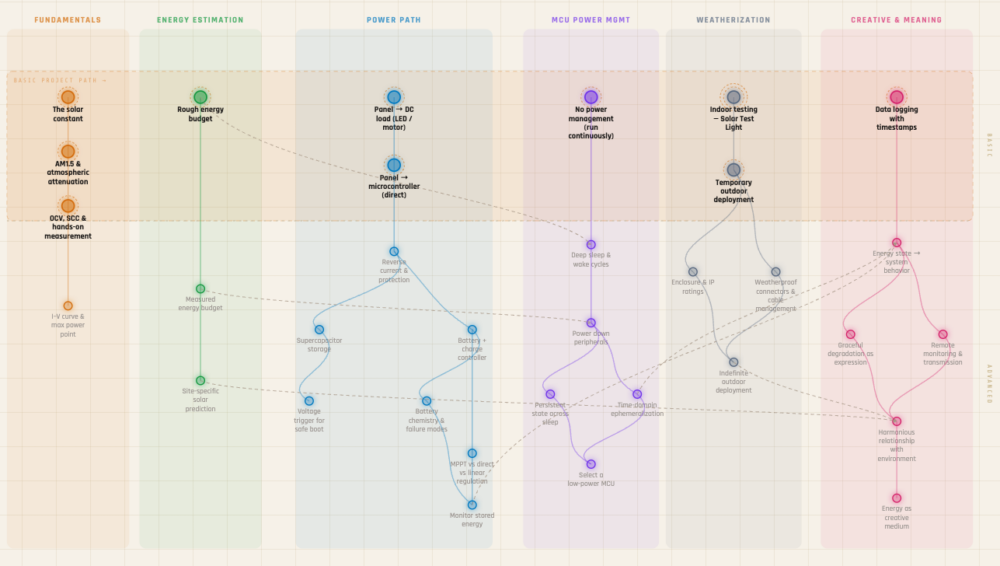
So: depending on your specific interests, solar availability, budget, etc.: let’s see if we can navigate the branches of this tree. You might start with a your project at a basic level in all categories; and then decide to focus on energy optimization or weatherization as a technical focus; all in service of a conceptual piece that you develop further as a final. Let’s see! (Also – bug bounty for anyone who finds a factual error or hallucination. I’ve been spot checking…)
- Basics:
- Understand the solar constant, AM1.5, and efficiency to evaluate the maximum power potential of solar
- Understand the relationship between light, OCV, SCC, grounded through measurements
- Use a solar panel to control a basic DC load like a motor or LED
- Use a small-to-medium solar panel to directly power a small microcontroller project
- Next steps:
- Estimate project power requirements to make a rough energy budget.
- Measure project power requirements to make an accurate energy budget
- Implement power-saving strategies such as powering down peripherals (on and off board), deep sleep, and time-domain ephemeralization*
- Select a microcontroller specifically for it’s low-power operation
- Implement persistent state across deep sleep and/or power loss
- Store energy in a capacitor
- Use a voltage trigger to prevent chip boot until stored energy is sufficient in capacitor
- Store energy in a battery with appropriate charge controller circuit
- Create a project that can withstand outdoor environments temporarily.
- Next-next steps:
- Predict available site-specific solar availability using location, seasonal data, and shademaps
- Actively monitor stored and available energy and use measurements to inform system behavior
- Create a project that can withstand outdoor environments indefinitely.
- Create a project that lives in harmonious relationship to the environment and available energy
- Create an inspiring/challenging/beautiful work where solar energy is central to the concept of the piece
Solar Learning Goals
- Appreciate sun as ultimate origin of almost all terrestrial fuels and energy sources
- Touch on nuclear fusion and fission
- Know the value of the solar constant and AM1.5 solar flux value
- Learn basics of photovoltaic (PV) conversion of light to electricity
- Learn about specific materials and considerations that affect PV
- Learn about emerging technologies in PV such as perovskites and quantum dots
- Learn about the difference between grid-tied and off-grid PV
- Learn about the additional components needed for both types of PV
- Learn about energy storage in batteries
- Apply energy storage concepts from capacitors to batteries (specific energy, etc)
- Learn about different battery chemistries and other factors that affect battery performance
- Learn about grid-scale battery energy storage
- Learn about grid-scale PV installations
- Appreciate difference between PV and solar-thermal power
- Build a realistic power budget for a project
- Apply methods for reducing the energy consumption of your projects
- Design projects that tolerate intermittent or irregular power supplies without faults
- Design a project that can realistically survive outdoors
- Test solar panels using concepts of OCV and SCC
- Understand MPP in PV and Jeff’s rule-of-thumb for MPP
Final
For a final project for this class, you may:
- Expand your solar project
- Expand your kinetic project
- Thoroughly integrate concepts from the class with the final for another class.
Some of you will want to do something completely novel for the final. In general, a good Energy class project does one or more of the following:
- Accounts for the energy used accurately, with appropriate estimates and direct measurements when possible.
- Is itself about energy, clarifying energy concepts or illuminating energy use.
- Obtains all of its energy from the environment, without need for primary batteries or a grid connection.
- Makes a positive difference in the world!